No Added Parameters, Let the Model Think More Times: Looped Transformers Become a New Trend
Sebastian Raschka's architecture gallery already has 5 looped transformers. LoopRes pushes loop fine-tuning from marginal gains to +29.1% at 2x compute. But questions remain about decode speed and adding parameters at the same FLOPs.
Sebastian Raschka's LLM Architecture Gallery already contains 5 looped transformers. After GLM-5.4 was released, he wrote on X: I see a trend :), along with an architecture diagram.

A normal Transformer basically runs each layer once; to make it stronger, you add layers and parameters. Looped transformers take a different approach: they run a middle group of layers several times, while the embedding and output head stay unchanged. A reply mentioned that GLM-5.4 loops the middle 28 layers, with the embedding and head kept as is. In this way the same set of weights is called multiple times: parameters do not increase, but compute does.
Someone asked whether GLM-5.4 is the first at this scale to do loops, and Sebastian replied that it is at least the first with open weights, because Astra did not disclose its scale. This judgment is more concrete than the trend itself: looped architectures are starting to move from a technique in papers into a downloadable, comparable model list.
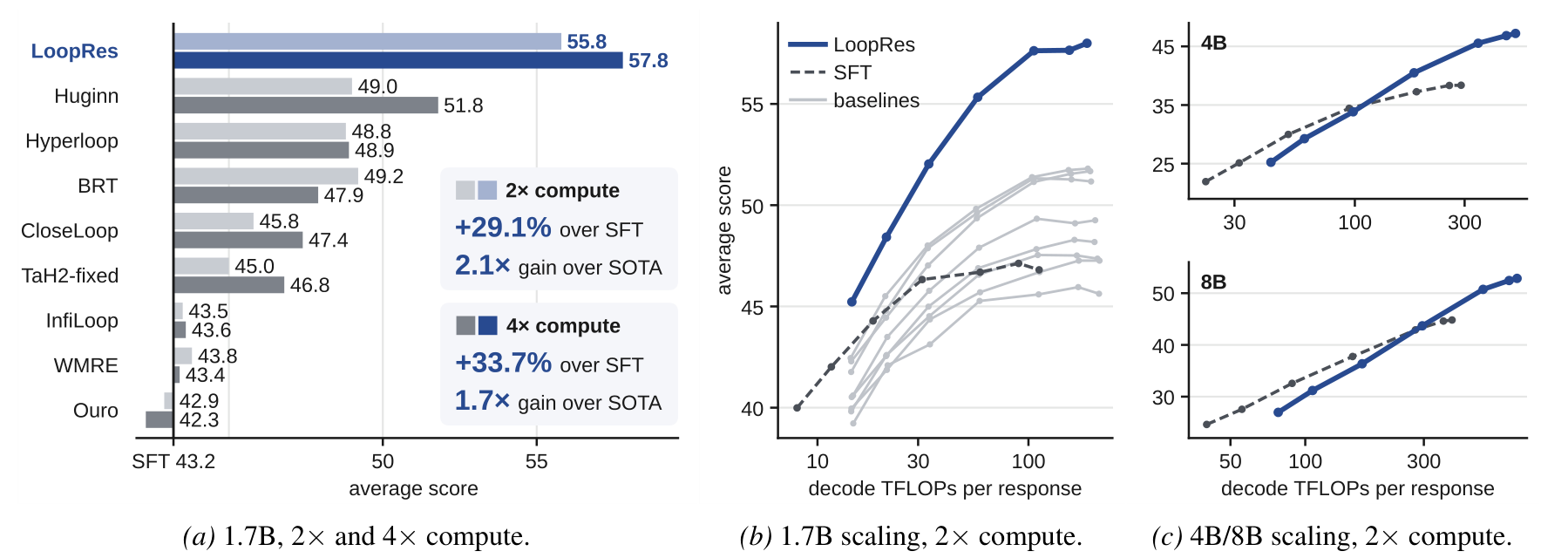
LoopRes, released by Xuanlei Zhao et al. from NUS, exactly explains the technical motivation behind this trend. The paper is titled Unlocking the Power of Loops in Pretrained LLMs with Loop Residuals. It first points out an awkward fact: fine-tuning a pretrained LLM into a looped structure has previously been only slightly better than ordinary SFT. There are two reasons. First, the outputs of the same block in different loops are too similar, and Attention Residuals cannot tell which is which. Second, when there are too many sources, layers become lazy and skip intermediate loops. The paper says that with 7 loops, only 0.05% of the weights go through all loops.
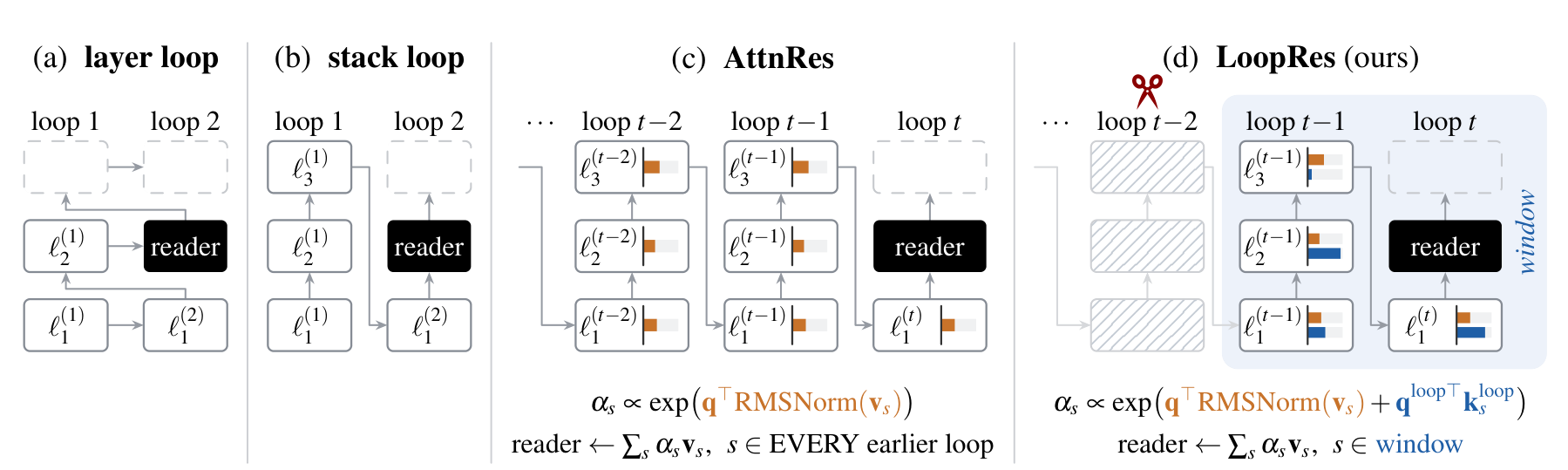
LoopRes has two very concrete changes. Each block gets an extra trainable key for each loop, so the layer knows which round this source comes from. Each layer only looks at the most recent W loops; in the paper W=1 is best, which both prevents skipping too far and holds down the number of input sources. Training cost increases by only 4.8% step time and 0.7% peak activation memory.
The results are also direct enough. On Qwen3-1.7B-Base, at 2x compute the average score is 29.1% higher than SFT; at 4x it is 33.7% higher. Among the 8 looped baselines in the same setting, the strongest one is only 13.9% higher at 2x compute. The paper also tests 6 pretrained LLMs, 3 model families, and 9 benchmarks.
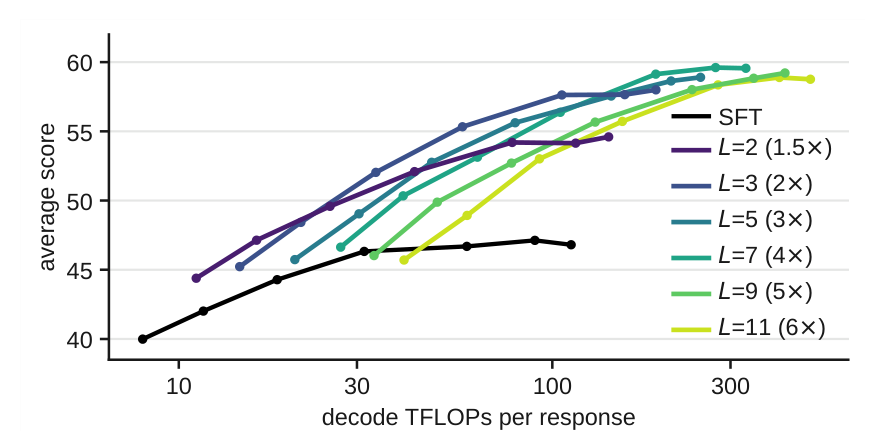
More interesting is scaling. As loop depth goes from 2 to 11, the score first rises and then gradually saturates after L=5; L=3 has the best cost-effectiveness. Qwen3-4B with LoopRes has an average score of 45.8, exceeding ordinary SFT Qwen3-8B's 42.9. The authors therefore call looping a new axis of test-time scaling: when outputs are long, it saves more compute than SFT and also has a higher ceiling.
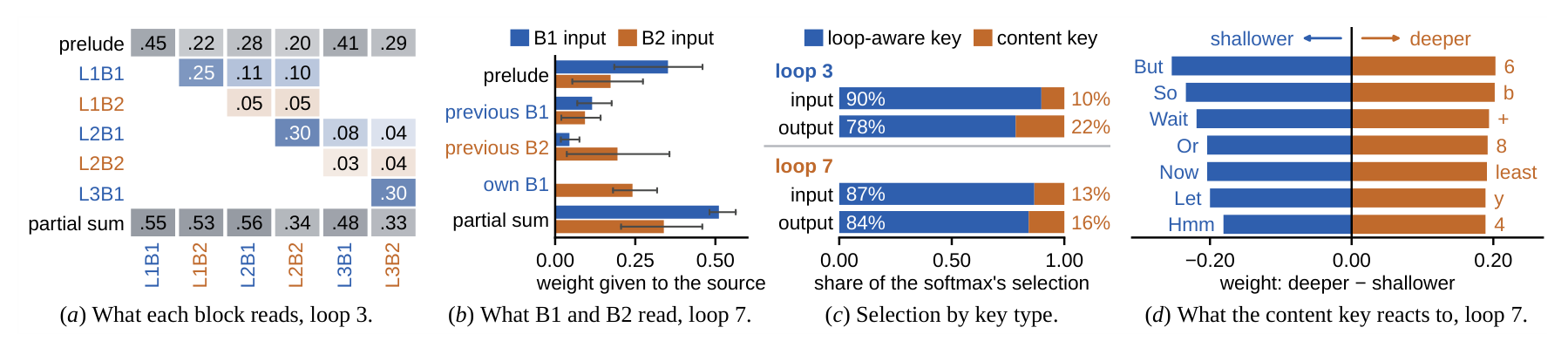
The paper also looks at what the model learned. The loop-aware key dominates source selection, while the content key lets different tokens choose different depths: simple tokens tend to prefer shallow outputs, and numbers and mathematical symbols tend to prefer deeper ones. This detail is more vivid than the average score: the model is not stuffing every token through the same number of loops; it is learning who needs to think more.
These results look good, but two questions in the tweet replies are worth keeping. From a hardware perspective, Denis Cherniavsky asked: during decode on a laptop, memory reads are the bottleneck, and looping repeatedly reads the same set of weights; two loops may be close to the speed of an 8B model while memory usage is still 4B. Did the paper actually measure decode tok/s, or only look at FLOPs? The author did not elaborate in the thread. Yixuan Tan's question is more direct: if you spend the same extra FLOPs, would simply adding parameters produce better quality?
The discussion about local deployment is also practical. Grygorii said GLM-5.3-Flash absolutely would not fit on his 96 GB Mac, and on 256 GB it runs at 99 tok/s single-stream. He wonders whether GLM-5.4 changes the memory ledger or burns the saved memory on extra passes. Noé Flandre is more optimistic: MoE is unfriendly to devices with little VRAM, and looped models may be so slow that they need to run overnight, but at least they can run.
The old shadow of looped architectures also came up. One reply joked that models have now become one big RNN. Another reply asked whether the biggest difference among the five models is the number of loops or the layers being repeated. LoopRes's ablation answers part of this: too large a window actually lowers the score, and W=1 is best; loop-aware key and content key are both indispensable. But dynamically deciding the number of loops per token has not been done yet; the author says this is a natural extension and will try it.
So, 5 models show that looped architectures have gone from a technique in papers to an engineering option. What it addresses is the trade-off between parameter storage and compute; it does not solve latency. For local AI, it may let large models run on machines without enough memory, at the cost of slower tok/s. For cloud services, whether it is more cost-effective than simply stacking parameters depends on same-FLOPs comparisons and the cost of long outputs. The trend is real, but the conclusion is not here yet. What is worth watching next is not when the 6th looped model appears, but whether anyone fills in the comparisons on decode speed, long-output cost, and adding parameters at the same FLOPs.
发布时间: 2026-11-25 10:04