One request, 128 candidate paths: vLLM-GR packs beam search into recommender systems
vLLM releases vLLM-GR: generative recommendation models run beam search directly, exploring 128 candidate paths per request. P99 is 369 ms on H20, versus 1280 ms for SGLang. Supports NVIDIA GPUs and Huawei Ascend NPUs; OneRec-1.7B is runnable.
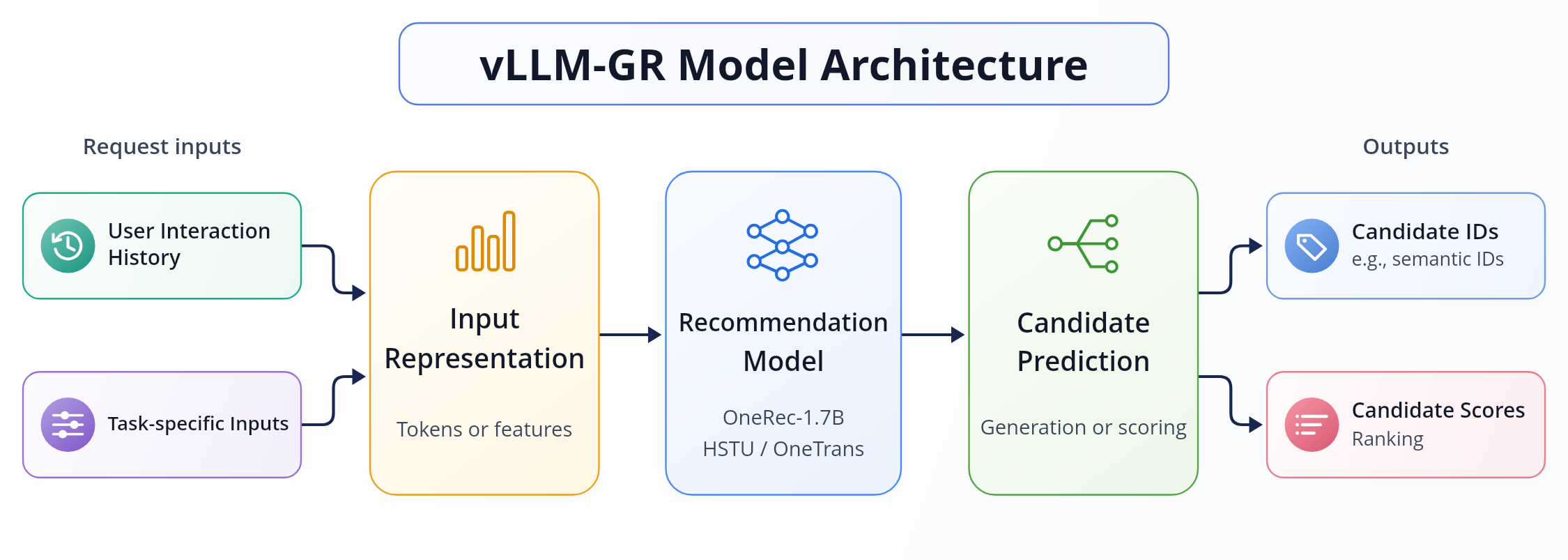
The vLLM team has released a new project: vLLM-GR. It is an inference framework built on top of vLLM for generative recommendation models. In one sentence, the core feature is: beam search runs inside the engine, and a single request returns multiple candidate paths.
Generative recommendation and ranking from a candidate pool are two different approaches. In the former, the model directly generates a semantic ID, and this ID corresponds to a product or a video. The model reads the user's interaction history and outputs a SID; the recommendation system uses this SID to look up content in the item catalog.
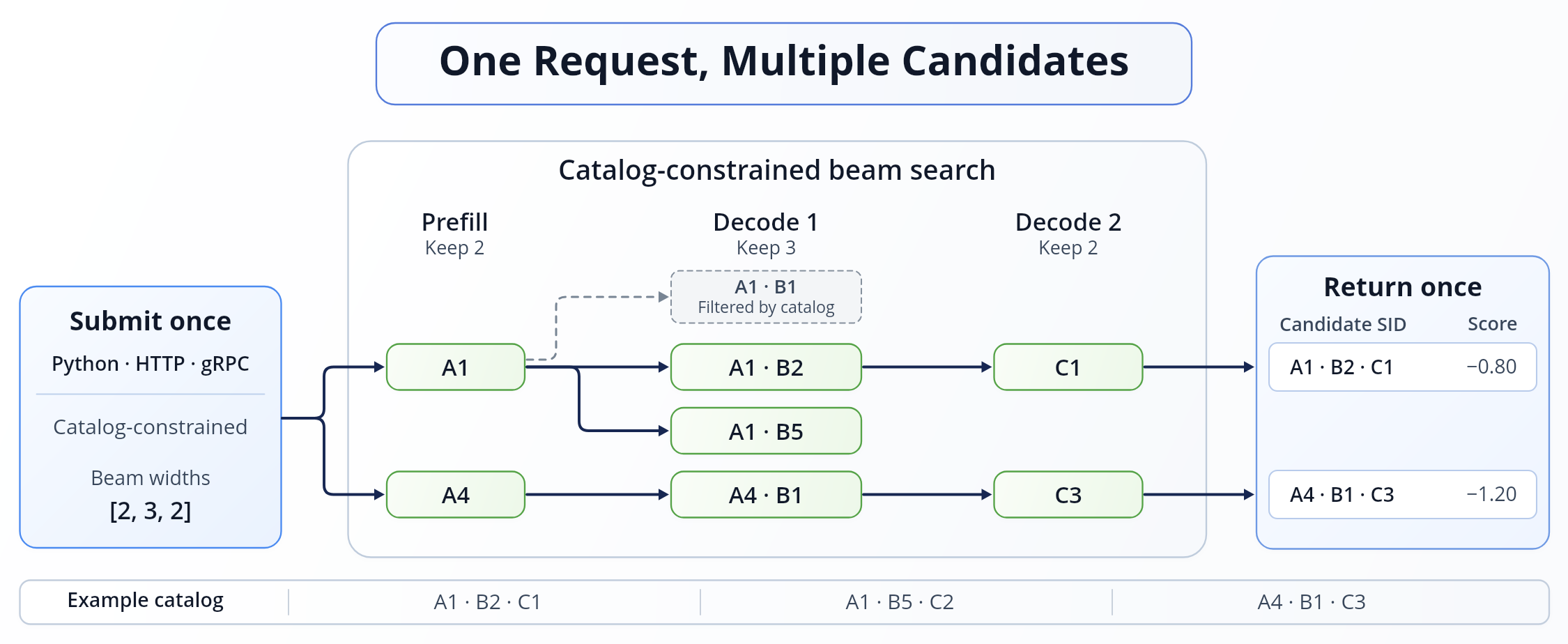
An information feed page does not need one candidate; it needs a screenful. Generating one ID at a time is equivalent to sending dozens of requests, each of which rereads the user history. vLLM-GR lets a single request run the entire beam search and return dozens of candidates at once.
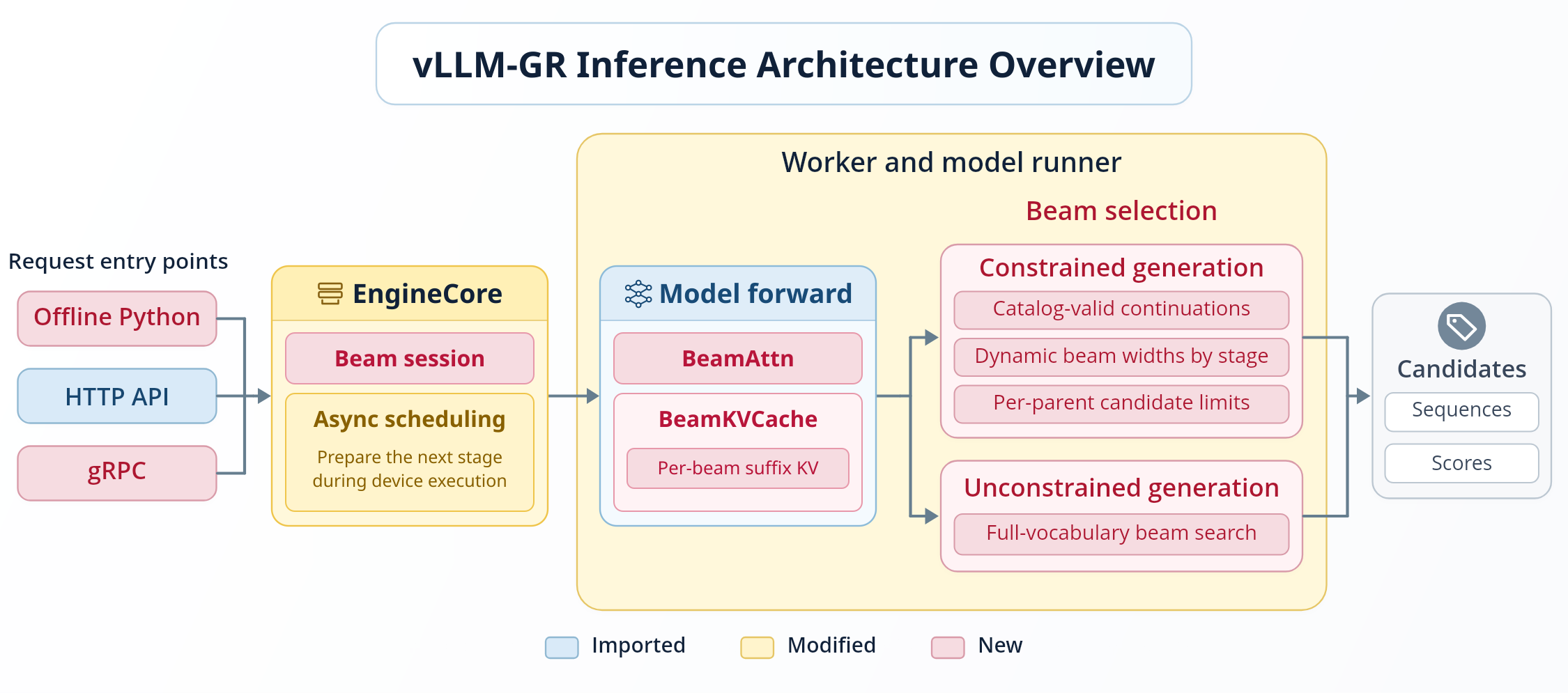
vLLM-GR adds a beam session inside the vLLM engine that spans the entire search process and tracks how candidate paths branch. vLLM's native scheduler, model execution, and paged KV cache are reused directly.
Three key designs:
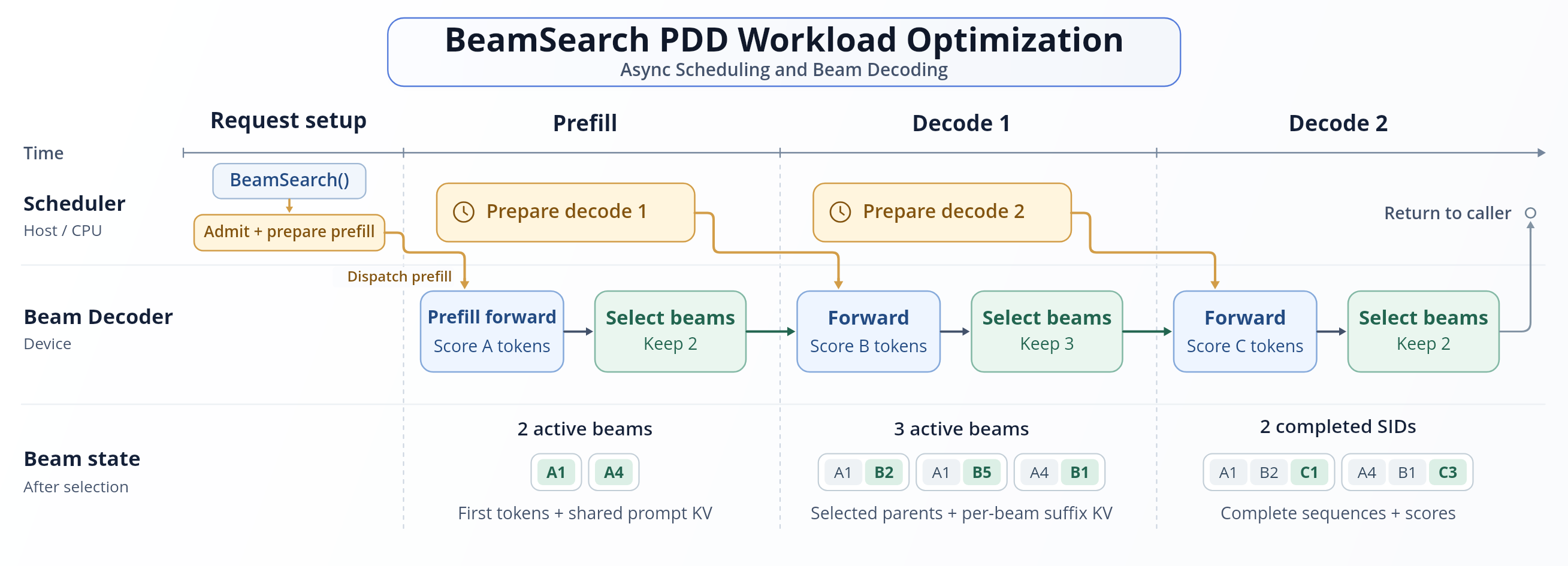
Shared prompt KV. All beams share the same user-history cache, so there is no need to copy it for each candidate. Each beam path retains only its own suffix KV, and the next decode step reads the corresponding KV state by parent index.
On-device beam selection. Catalog constraints ensure that the search does not generate IDs that do not exist in the item catalog. Beam selection and filtering are done on the device, with no need to coordinate back to the host at every step.
Asynchronous pipeline. While the device executes the current decode, the host has already prepared the inputs for the next step. Prefill and decode overlap, compressing the waiting time between stages.
The performance data comes from the official blog. Benchmark setups differ, so they cannot be compared directly across scenarios, but the trends are worth examining.
At beam width 256 and an input of 1024 tokens, vLLM-GR has the lowest P99 for batch sizes 4 and 8 across six accelerators. On H20 with batch 8: 369.4 ms. In the same setting, SGLang Beam (another inference framework) is 1280.1 ms, and NVIDIA SID-GR (NVIDIA's generative recommendation backend) is 428.1 ms.
At beam width 128, the results diverge. On A100 with batch 8, NVIDIA SID-GR is 199.0 ms and vLLM-GR is 209.7 ms. On RTX PRO 6000 with batch 1, NVIDIA SID-GR is also slightly lower. But on A5, vLLM-GR is the lowest across all batch sizes, with a P99 of 128.2 ms at batch 8. Wide beams are the scenario where vLLM-GR's advantage is most consistent; with narrow beams, different hardware trades wins and losses.
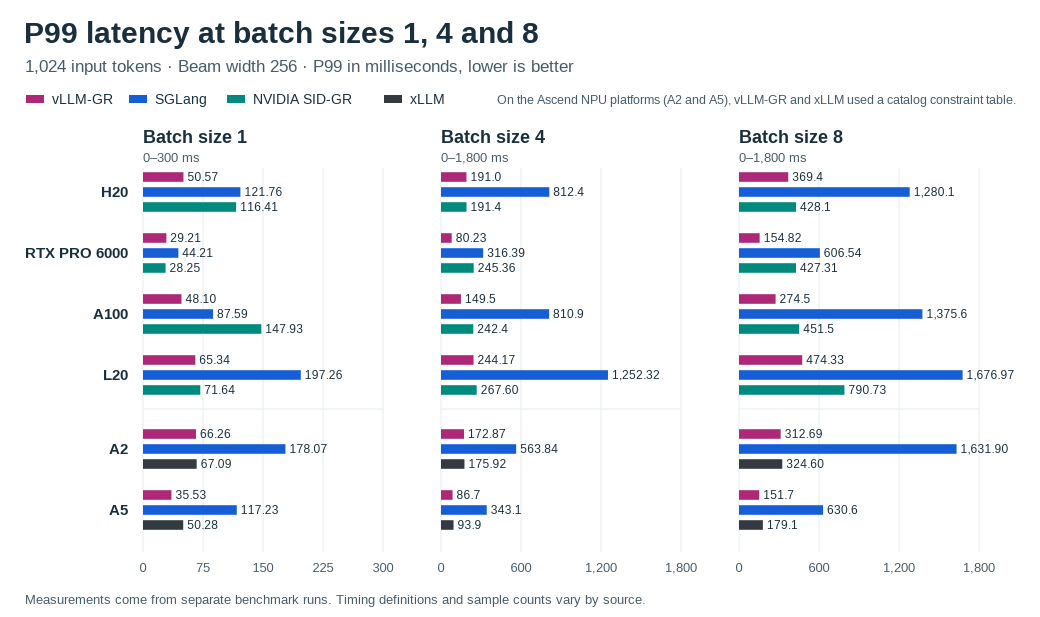
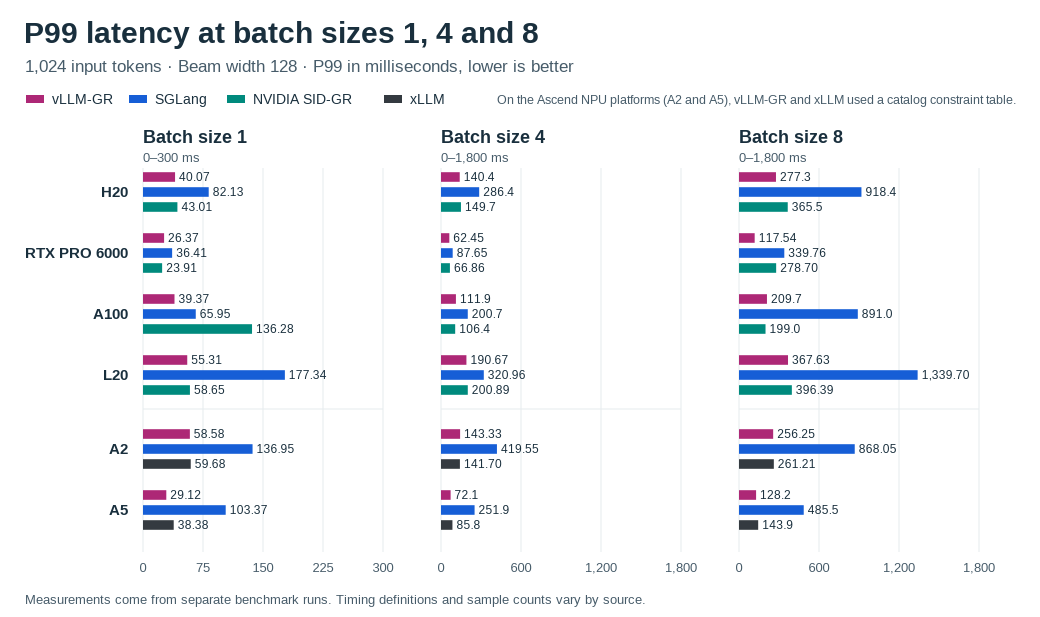
vLLM-GR 0.30.0 is based on vLLM 0.30.0 and supports NVIDIA GPUs and Huawei Ascend NPUs. It currently runs OneRec-1.7B, with three entry points: offline Python, OpenAI-compatible HTTP, and gRPC.
Several directions in the roadmap map directly to production bottlenecks:
- Online scheduler. It decides when to form batches and which requests enter the queue, lets requests with different history lengths run together, and remains bounded when the queue is overloaded.
- Long-history KV reuse. It reuses KV blocks for unchanged prefixes of user histories longer than 10,000 tokens to avoid repeated prefill.
- Distributed KV cache. It reuses KV blocks across devices and nodes to reduce redundant computation in long-history scenarios.
- Broader model coverage. Candidate scoring for HSTU, MTGR, and RankMixer; native serving for OneTrans; and MoE recommendation models. It will also regularly follow upstream vLLM updates to sync improvements in scheduling and KV cache management.
People in the community are already using it. Recsys Frontier says it is applying vLLM-GR to generative retrieval with OneTrans. One commenter said they would first benchmark beam search on accelerators, which is the most worthwhile part of the project to test. Someone asked whether catalog constraints require rebuilding the index when inventory updates in real time; the GitHub documentation answers: online catalog replacement is supported, but on CUDA it requires asynchronous beam execution.
Contributors include InferMatrix, Inferact, openPangu, TikTok Global E-commerce, ByteDance Data Architecture and Ads ML Infrastructure teams, and LingQuAI. Being so deeply tied to the recommendation business shows that this is not merely a demo that runs in a lab.
发布时间: 2026-11-25 12:59