12 Public AI Evals, 8 Misjudged Correct Answers as Wrong
Eugene Yan broke down 12 public benchmarks and found that the most common problem is not that the tasks are too hard, but that the grader marks correct work as failure. After one eval added requirements that had not been clearly stated, a model's score jumped straight from 63% to 89%. The higher the score, the more you should check whether the grader is holding it back.
Evaluation scores are the first piece of information most people use to understand a new model. But Eugene Yan recently broke down 12 public benchmarks, and the conclusion is not very optimistic: 8 of them have evidence that the grader marked work that should have passed as failure.
He published this analysis on eugeneyan.com under the title “Lessons from 12 Evals: Where They Break and What to Measure Instead.” Here are a few key findings.
What an eval task looks like
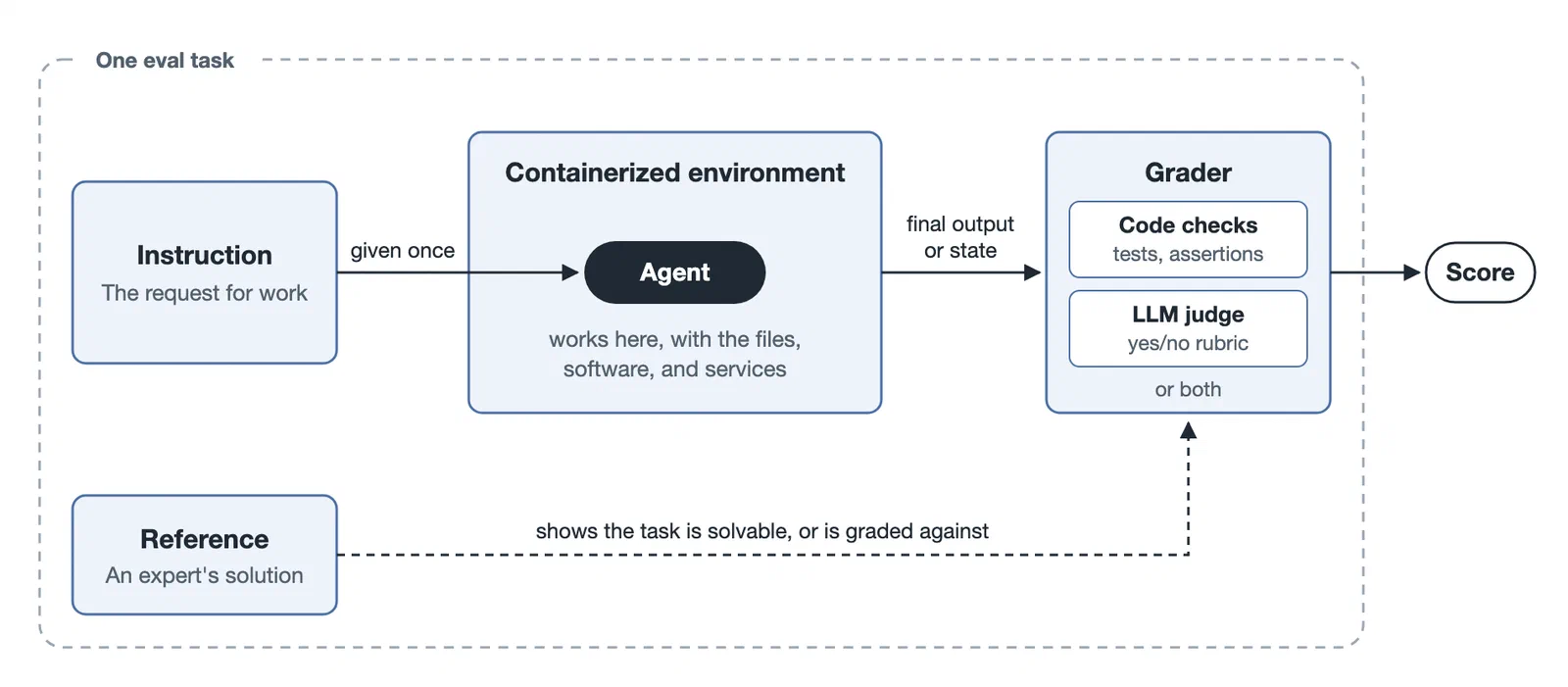
Most eval tasks consist of four parts:
- Instructions: a segment written like something a real user would write. The agent receives it only once at the beginning and usually cannot ask follow-up questions.
- Environment: where the agent works. It might be a container with a repository installed, or a VM preloaded with software and documentation.
- Grader: decides whether the work passes. It can be a deterministic code check, or an LLM scoring against yes/no criteria.
- Reference answer (optional): a solution written by a human expert, used to prove the task is solvable or as a baseline.
Evals themselves are increasingly maintained like software. Agents' Last Exam v1.1 retired 30 tasks and revised another 57. Harvey LAB's public tasks grew from about 1,250 when it launched in May 2026 to 2,010. Terminal Bench retires saturated tasks with each version, so scores cannot be compared directly across versions.
The grader is more worth watching than the task
Eugene Yan's exact point is that benchmark authors spend a lot of effort making tasks harder, but the graders have not kept up. Of the 12 evals studied, 8 had audits or issue reports finding that the grader rejected valid work, and some also let erroneous or hallucinated content through.
The trouble is that the stronger the model, the fewer mistakes the model itself makes, and the larger the share of bugs attributable to the grader. An audit of DeepSWE v1.1 found that at least 20% of tasks marked correct solutions as failure. The main reason was that hidden tests swapped in by the grader conflicted with tests the agent had written itself, so they did not compile. In other words, the more conscientiously the agent self-checks, the more likely it is to be marked wrong.
False negatives: marking correct work as wrong
This is the most common problem, usually caused by the grader being stricter than the prompt requires or inserting implicit requirements that were never written down.
Terminal Bench 4.0 has a typical number. Preference Model reimplemented 65 tasks and found that 41 of them were graded against undeclared requirements. After those requirements were written out clearly and shortcuts were closed, one model's score jumped from 63% to 89%.
BrowseComp's problem lies in its answer key. In OpenAI's human study, for 50 of 367 questions, the people solving them disagreed with the reference answer, accounting for 14%. Later another paper confirmed 10 errors among 200 questions sampled from BrowseComp-Plus.
Harvey LAB removed 17 unsatisfiable criteria from its held-out set. One public issue mentioned a criterion requiring a meeting date, but that date appeared only in the rubric and in none of the 13 data-room files, so it was impossible for the agent to get it right.
False positives: letting wrong work through
Assertions and rubric items usually check only whether some expected point exists; they do not check whether the rest is correct.
In AutomationBench, about 57% of assertions only check whether an email, a Slack message, or a record contains or excludes a certain string. There are 94 tasks that check whether a message contains a one- or two-digit number, such as “4.” If a date or ID contains that digit, it can pass. Another task requires an email to state clearly the number of ready and not-ready audit items, but the grader only checks whether the email contains “3” and “4”; writing the two numbers in reverse also passes.
Harvey LAB's situation is more extreme. Artificial Analysis used an LLM judge to check deliverables against source files and found that over 60% of deliverables that passed all criteria contained substantive hallucinations, such as wrong parties, amounts, or dates.
Single-turn instructions cannot test real work
Most eval instructions are given all at once. Real work rarely looks like that. Users usually start with a vague idea, look at a draft, add constraints, and go back and forth for several rounds.
Laban et al. found that models scored on average 39% lower in simulated multi-turn conversations than in single-turn ones. OSWorld 2.0 is one of the few evals that tests multi-turn interaction. Some tasks include a simulated user, and the agent can ask questions. Other tasks insert emails or chat messages midway that change the requirements. Its error analysis shows that agents tend to guess rather than ask.
Pass rate hides reliability
Most evals report average pass rate. Two agents both score 70%, so they look the same. But one reliably solves 70% of tasks every time, while the other has a 70% chance of getting each task right. In production, you can safely hand the former the 70% it handles; for the latter, you have to check every output.
Eugene Yan suggests additionally reporting pass^k: a task counts as solved only if it passes all k attempts. With five attempts, the first agent is still at 70%, while the second drops to 17%.
He puts it directly: he would rather pay twice as much for a model that finishes the job every time than pay half as much for a model that completes 80% and leaves the remaining 20% for you to debug.
Cost per task is a misleading metric
Evals usually average the cost of all attempts, including failed and abandoned ones. A model can keep costs down by doing less work and giving up early. In Agents' Last Exam, 17% of failures were agents stopping early or producing no deliverable. In FrontierSWE, one model under a 20-hour budget submitted and stopped within 8 hours in 169 of 170 attempts.
In GDPval's analysis, GPT-4o's cost per task was about one tenth that of GPT-5. But after accounting for expert review and rework time, GPT-4o was slower than experts doing the work themselves, and only GPT-5 was faster than experts.
What is truly scarce is human attention, not token cost.
Scores are a combination of model and harness
The same model will change score with a different harness. On Terminal Bench 2.0, one model scored 57.8% on Terminus 2, a neutral harness, but only 52.1% on its own provider's harness. Another model went from 32.6% to 19.6%.
On FrontierSWE, two models worked longer and scored higher on Proximal's own Proximus harness than on Claude Code and Codex.
For people building products, the conclusion is simple: test models in your own production harness; do not just move leaderboard numbers over.
Specific problems with several evals
Terminal Bench Science has an example that illustrates the all-pass scoring problem well. One task's grader required the categories and periods of 100 stars to all be correct. One run got 99 stars right, and the score was 0. If partial credit were also reported, this task should have been 0.99.
HealthBench Professional's rubric is thin. Its 525 tasks have only 1,135 criteria, averaging two per task. The original HealthBench has about 11 per task. An independent analysis found that 47% of tasks had only one positive criterion. The score may reflect only whether the answer hits the one or two checkpoints selected by doctors.
GDPval's human expert graders agree with each other 71% of the time. A grader model trained to perform the same pairwise comparisons agrees with humans 66% of the time. Knowledge work is inherently subjective, so score noise is considerable.
OSWorld 2.0 had external reviewers find that in 23 of 108 tasks, the grader rejected valid work. One grader required a free-text field to exactly match a short name, but the task's own website displayed the long name; filling it in according to the webpage actually lost points.
How to think about eval scores
Eugene Yan's advice is to dig one level deeper when looking at scores: what the tasks look like, how the grader is written, whether the metrics reflect reliability, and what the error analysis says. Public benchmark scores can be used to narrow down candidate models, but in the end you need to rerun them in your own harness.
The end of his article says it plainly: public evals are more realistic and better engineered than ever, but they are still some distance from being reliable.
12 evals, 8 marked correct answers as wrong. That ratio itself shows that the problem is not the models; it is the design and maintenance of the evals.
发布时间: 2026-11-25 18:32