A Free Skill Turns Any Topic Into a One-Minute Explainer Video—While the Comments Ask: Then What?
Peter Yang open-sourced /video-explainer, with three styles, voiceover and subtitles, generated with one command. The course demonstrates how to build it with Antigravity and Gemini 4 Neon. The comments are more worth reading: making it is easy; getting people to watch past the 7-second mark is hard.
Peter Yang open-sourced a free skill called /video-explainer on X. Enter one command, such as /video-explainer how do black holes form, and it generates a short video explainer with narration and subtitles. The materials provide three styles: motion graphics, hand-drawn illustration, and cinematic 3D. It can also be used to generate more everyday content, such as a visual itinerary for a trip to Japan.
GitHub repo: https://github.com/petergyang/video-explainer . Peter Yang says if you find it useful, you can star it so more people can find it.
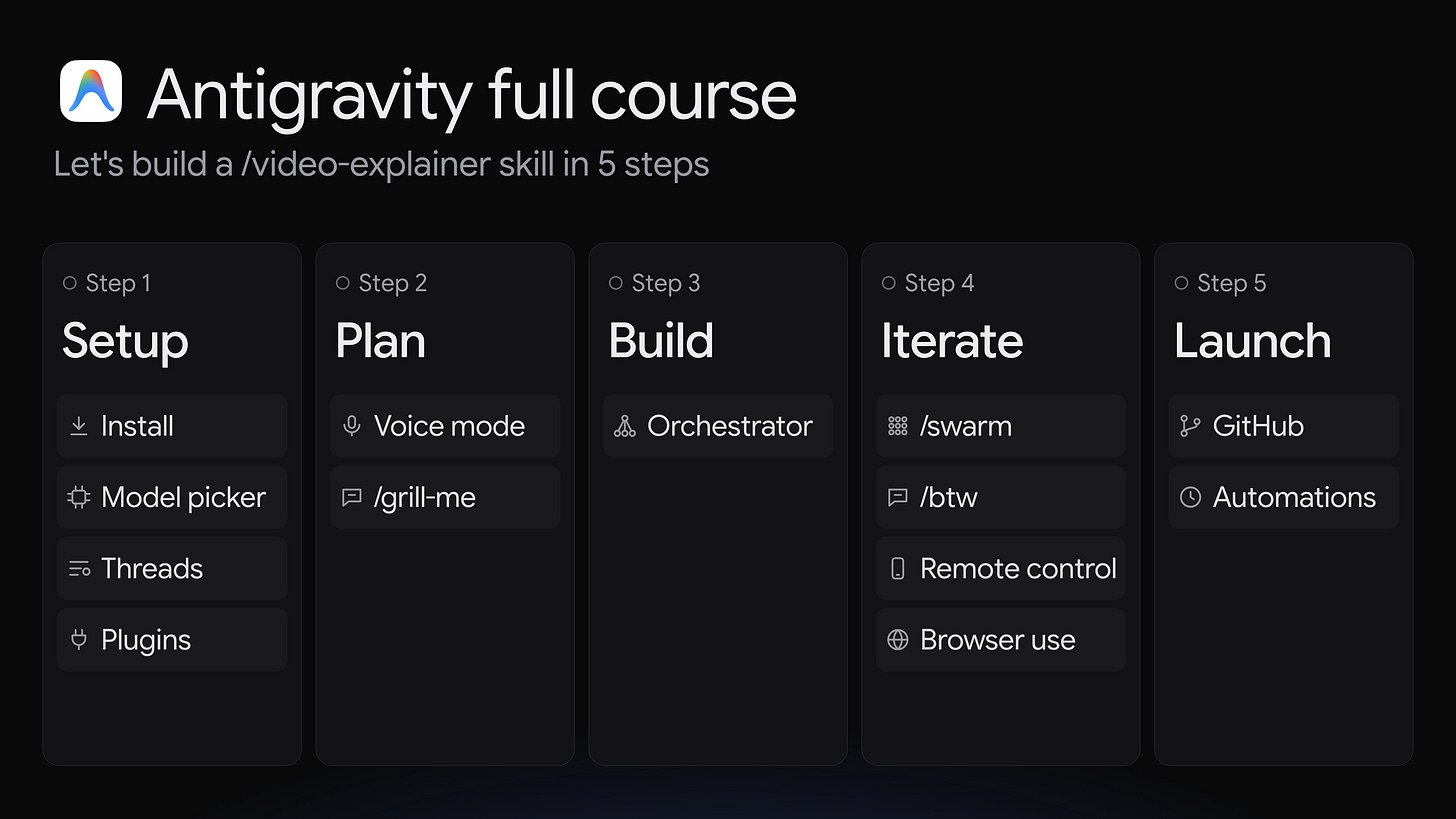
Under the hood, this uses Google's Antigravity and Gemini 4 Neon. In replies, Peter Yang posted a full course showing how to build this skill from scratch: install, choose models, organize threads, connect plugins, then use Orchestrator and voice mode to make a plan, use /grill-me to interrogate the plan clearly, and move into building and iteration. The course also mentions /swarm to run multiple agents in parallel, /btw for interjecting questions, remote control and browser use, and finally publishing the skill to GitHub and setting up automatic weekly explainer video generation.
Course video: https://youtu.be/7I8B7CQky0Y
Step-by-step guide: https://creatoreconomy.so/p/gemini-4-neon-and-antigravity-full-course
One detail in the demo is quite grounded. The black hole explainer video did not come together in one pass. The first version looked like a slide deck, and Peter Yang gave feedback that it was too boring: it needed camera movement, object animation, and every concept explained visually. The second version was noticeably better. The third added sound design, a music bed, word-by-word visual sync, multi-layer parallax, and illustration texture. This process is more informative than "one-click generation": the model can produce a draft, but pacing and taste require a human to keep revising.
The comments weren't all applause. One user said they used code this week to make a 15-second explainer, and that production was the easy part—getting people to stay past the 7-second mark was the hard part. Others questioned the claim that "the best way to learn is to have AI make short video explainers," arguing that passive watching is still no substitute for building something yourself. Some didn't want to see another black hole demo and wanted to throw the skill directly onto a repo and try it. Another asked whether token consumption is high. The public post didn't provide specific numbers.
This feedback is more interesting than the tool itself. Explainer videos lower the barrier to understanding by turning abstract concepts into shots, narration, and subtitles. They are good for quickly building intuition, and for explaining itineraries, processes, and concepts clearly. But once the barrier to generation drops, the competitive edge shifts from "can it be made" to "is it worth watching to the end." Fast production does not mean the narrative holds up automatically. Open-source skills will produce more explainer videos, but attention won't increase because of that.
For developers, this repo is worth taking apart to study the workflow: how plans land, how feedback enters, how agents run in parallel, and how videos are assembled. For ordinary users, it offers a more intuitive way to express things—like replacing a search answer with an explanation you can actually watch to the end. Peter Yang's course shows the building process, while the comments leave another question: after the video is generated, who is responsible for getting people to watch past the two-second mark?
发布时间: 2026-11-26 00:31