Agent Logs Keep Piling Up—So Why Still Can’t You Tell Whether It’s Getting Better?
LangChain proposes agent lake: traces record what the agent did, while outcomes show how well it did. When storing data, record outcome signals alongside it—only then is there a closed loop for continuous improvement.
LangChain published “The Agent Lake” on November 24. Xudong Han said on X that it is worth agent teams reading carefully, and Harrison Chase reposted it. The article addresses a very concrete problem: the longer an agent has been live, the more traces accumulate. Many teams have stored every execution record, yet still find it hard to answer whether the agent is actually getting better.
First, let’s clarify two terms. A trace is the record of one agent run, from user input to each model call and tool call, all the way to the final output. Multi-turn conversations are grouped into a thread for review. An outcome is a result signal that indicates whether the work had an impact. For a coding agent, whether the PR it wrote is ultimately merged says more than whether each step in the process looked smooth. Harrison Chase’s view is that traces and outcomes should be looked at separately. Traces record what the agent did; outcomes show how well it did. He also warns that thumbs-down feedback, LLM scoring, and PR merges each have their own biases. If the feedback is skewed, automated improvement will amplify the errors.
LangChain has a name for this setup: agent lake. It is defined as storage optimized for agent traces, plus intelligent compute to query, analyze, and learn from those traces in order to drive continuous agent improvement. LangSmith ingests traces from billions of agent runs each month, and some customers, such as Clay, send hundreds of millions of events per day. At this scale, ordinary databases and reviewing traces one by one cannot keep up. They built SmithDB for this purpose, specifically to handle the real-time workload of agent traces.
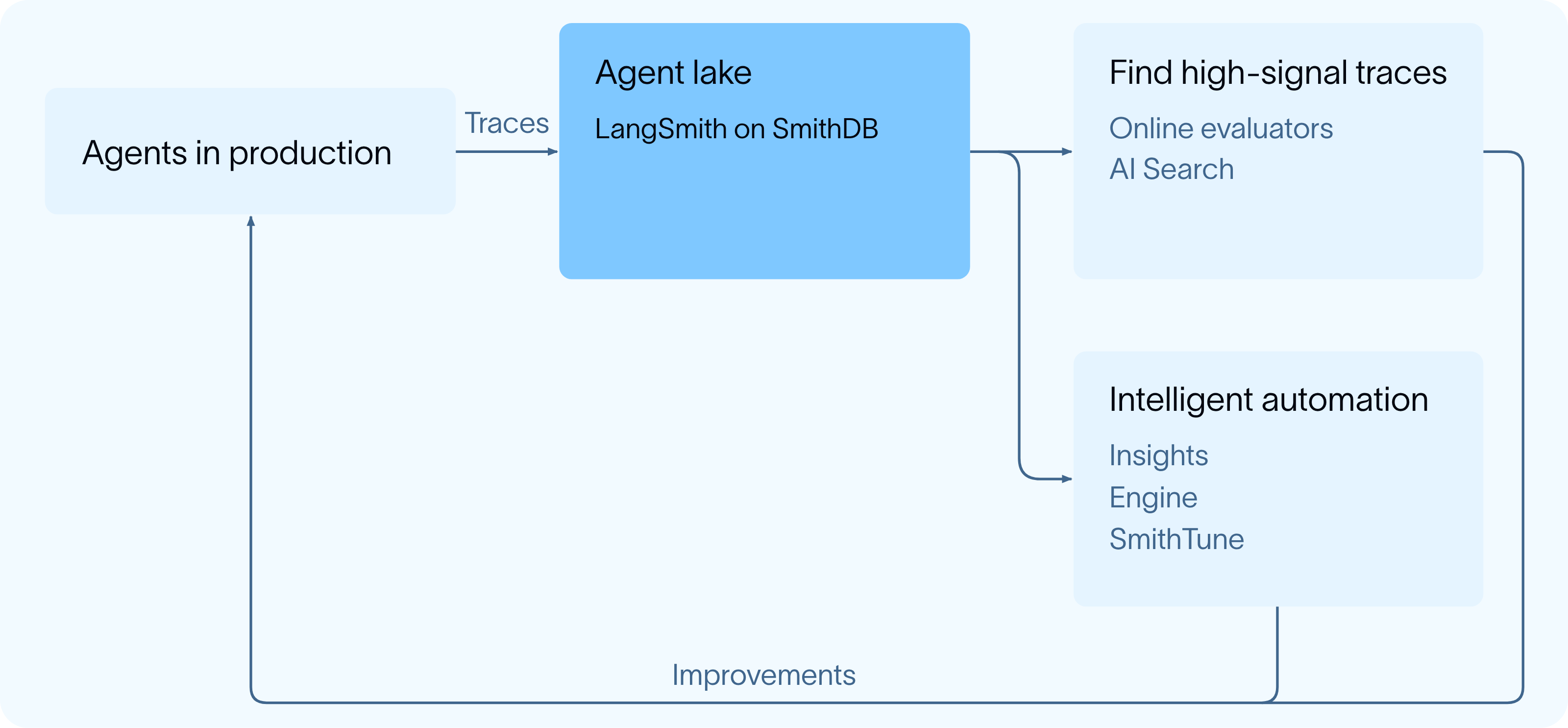
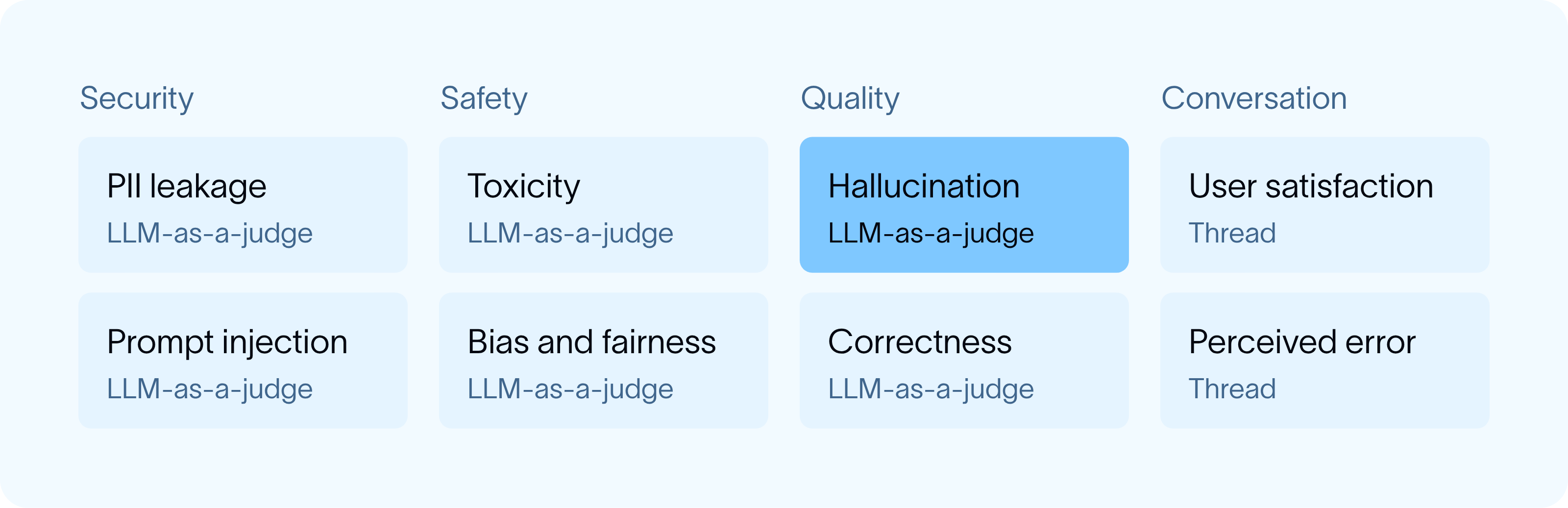
Intelligent compute has two parts. The first is finding high-signal records among massive numbers of traces. Online evaluators first label traces, for example for hallucination, toxicity, or user satisfaction. LLM-as-a-judge is expensive. After TypeSafe AI launched decision models in September, LangSmith integrated several decision models to classify traces at lower cost. Another method is AI Search, which lets you search traces in natural language, for example “threads where users were frustrated” or “traces containing PII.” The search results then go through a decision model for semantic filtering, and this can also be combined with structured queries.
The second part is automated improvement. Insights groups recent traces and answers “where is the agent failing”; as new conversations come in, it continues to classify them, making it possible to see which types of requests are getting worse. Engine scans traces on a schedule, groups recurring failures into issues, and uses eval scores and user feedback to decide where to look first. Once connected to a code repository, it diagnoses root causes and proposes a fix PR. Engine v2 can also test the fix against an eval set before the team sees it. The article says Engine has already analyzed more than 60 million production traces. For problems that cannot be solved by changing the harness, teams can use SmithTune to fine-tune. It is a CLI that uses Fireworks or Baseten to train models on high-performing trajectories, then compares them with base models back in LangSmith. LangSmith tried this on Engine itself, fine-tuning Kimi K3 on trajectories from one of Engine’s agents. On a subset of IssueBench, the fine-tuned model scored 96, while the base Kimi K3 scored 90 and GPT-5.6 Sol scored 87.
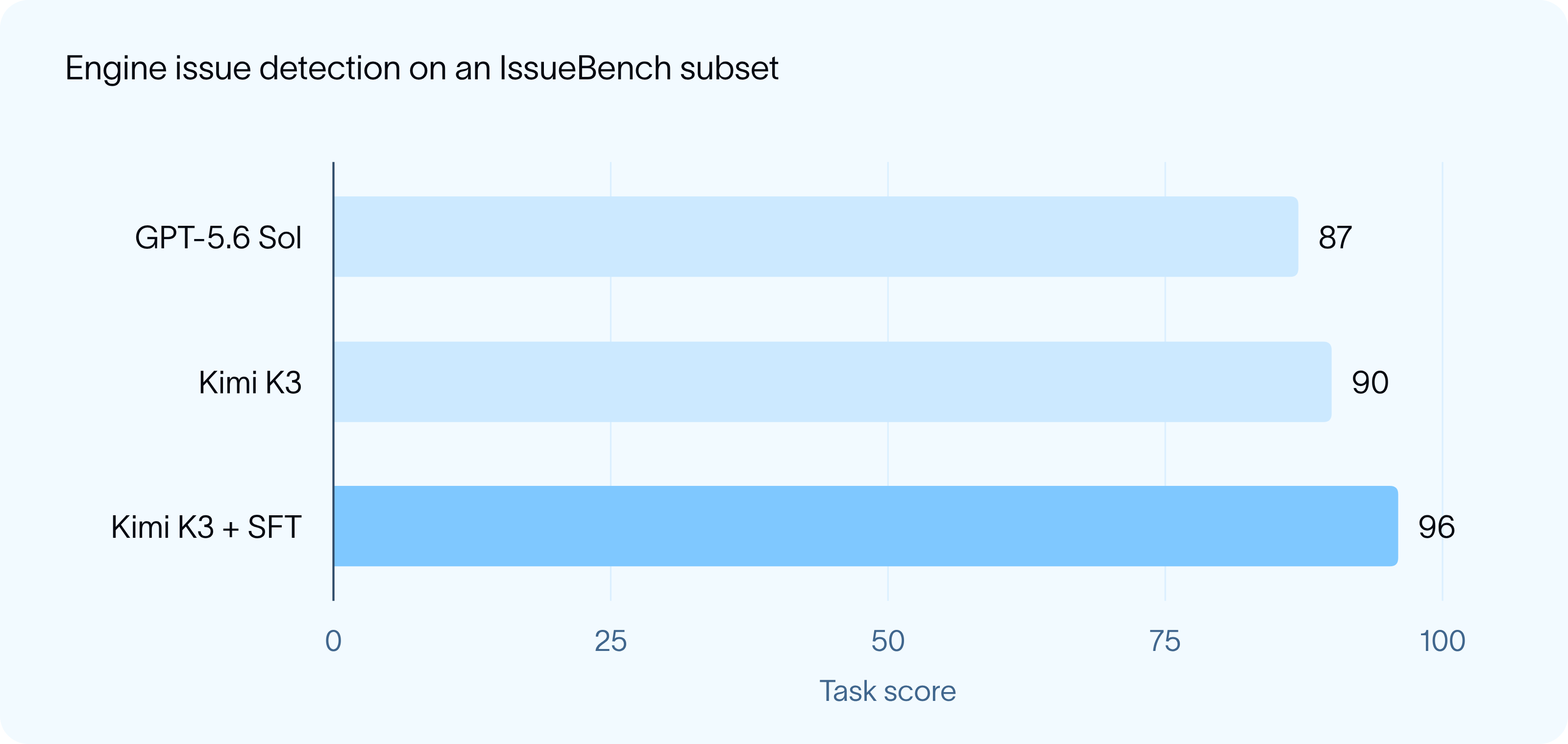
These numbers come from LangSmith’s internal benchmark, not a third-party evaluation, so treat them as preliminary. This article is also essentially a LangSmith product piece, so its capabilities and case studies should be discounted. But the closed loop of “trace plus outcome, filter, fix, train” has broad value for teams building agents. The step most easily overlooked is recording outcome signals when storing traces. Even just a PR link, a user thumbs-down, or a copy action. If you store only execution records and not outcomes, then no matter how large the log store is, it is still hard to answer whether the agent is getting better.
Original article: https://www.langchain.com/blog/the-agent-lake
X discussion: https://x.com/hwchase17/status/2125818274437013531
发布时间: 2026-11-26 21:29