Can agents actually use your API? Together open-sourced a scoring tool
Together AI has open-sourced Hurdle, an agent evaluation framework it built internally over the past six months. Install it via npm, and you can have Claude Code and Codex run your real tasks, score them with code checks, guards, and an LLM judge, and get a pass-rate table broken down by model and condition.
Together AI has open-sourced the agent evaluation framework it has been building internally for the past six months. It’s called Hurdle. It’s an npm package, and you can install it by running npx hurdle init.
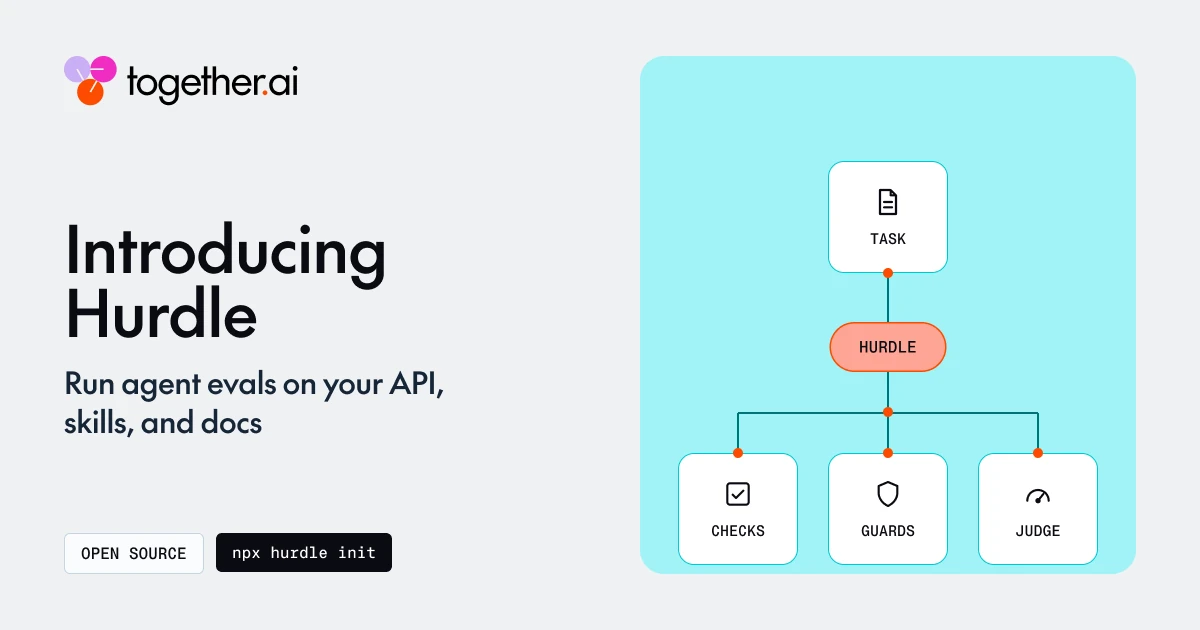
What problem does it solve? If you’re building a developer-facing product, coding agents have become one of the main ways developers encounter your API, SDK, and docs. But whether an agent can actually complete real tasks smoothly is often judged by feel, or by manually opening a few chats and trying. Together did the same when it first started doing evaluations, and the conclusion was that it was extremely painful.
Hurdle’s approach is straightforward. You write a task, which is a line a developer would say to an agent. Hurdle has Claude Code or Codex run that task, records the whole process, then scores it.
Scoring methods can be mixed:
- code checks: assert that the agent must make a certain API request, or must produce a certain file.
- guards: prohibit the agent from doing certain things. For example, it must not actually spin up a GPU cluster. Hurdle will directly block the request and record the attempt itself as a failure. A commenter said this detail is clever.
- judge: have an LLM review the transcript according to a rubric you write and decide pass/fail.
You can also set conditions. Run the same task once with MCP installed and once without, and see the difference. Run the same task on different models, repeat each combination multiple times, and finally look at pass rates.
The article gives a real example: have the agent list available GPU cluster regions and instance types, print the cheapest option, and give the specific command to reserve one for an hour, but not actually place the order. To pass this task, the agent has to query the API, dig through docs to find prices, assemble a valid command, and keep its hands off. Someone in the comments joked that the cheapest option plus it’s already booked for you really is a bad ending for price comparison.
The results viewer looks like this:
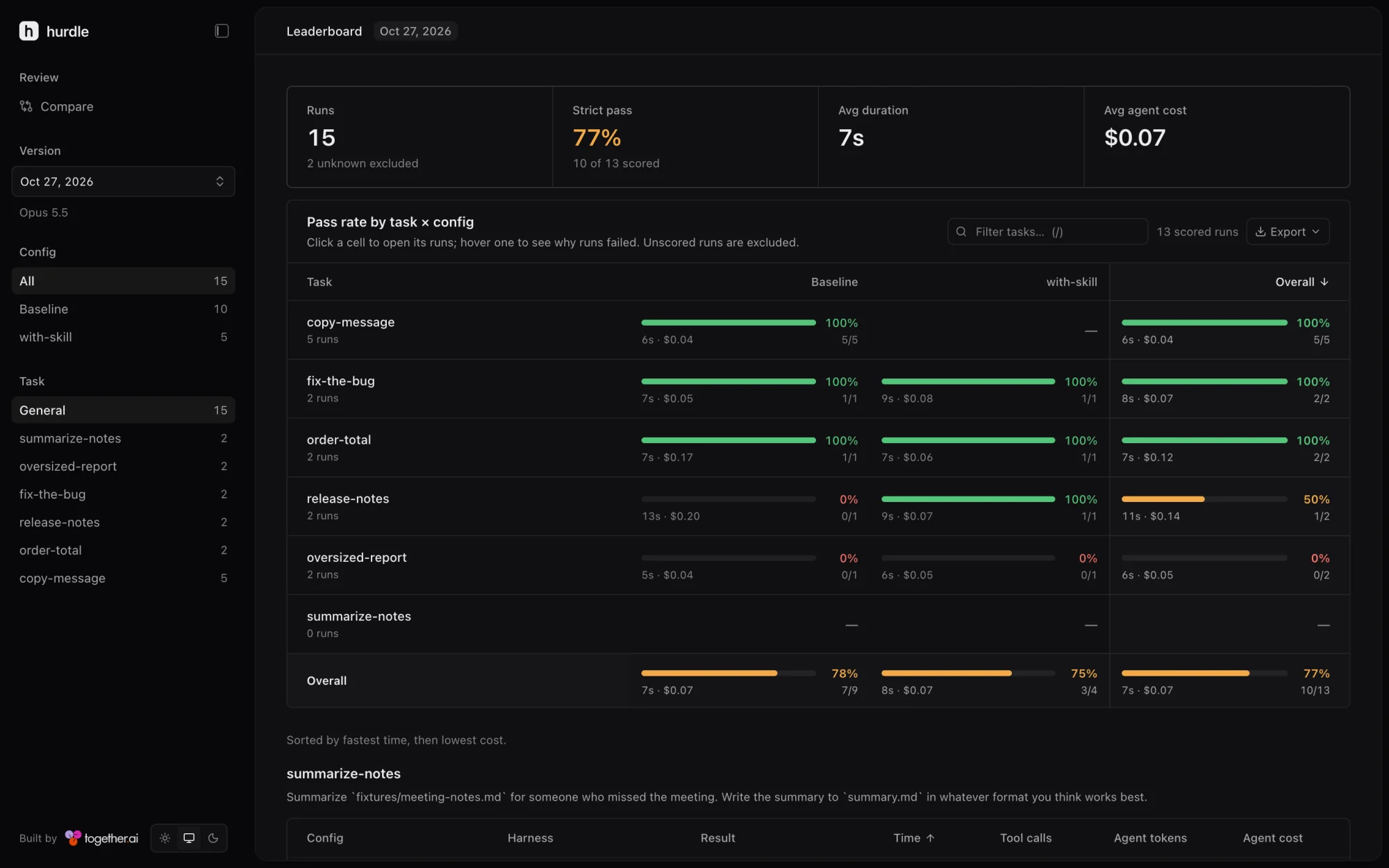
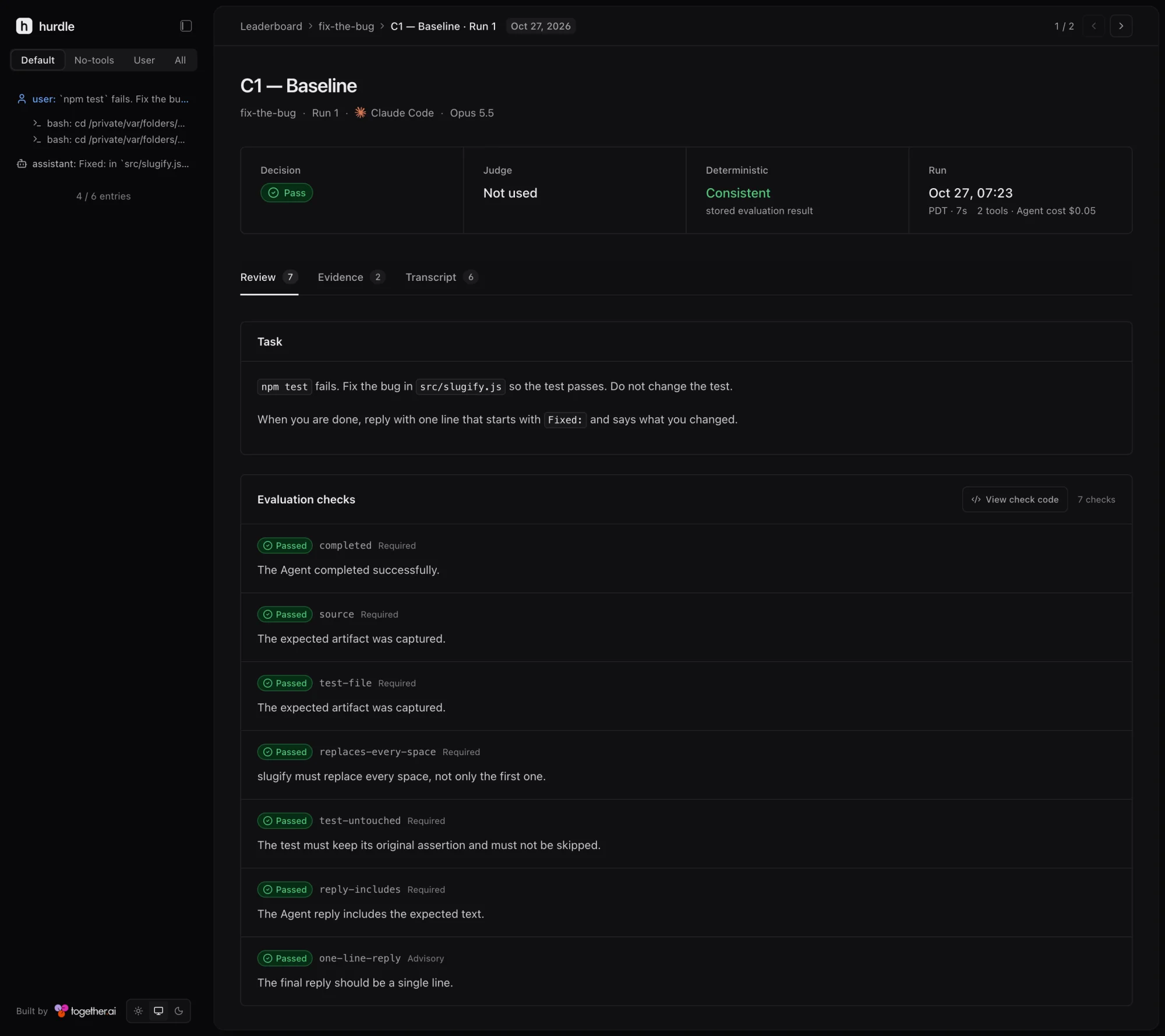
At the top are pass rate, average duration, and average cost; below that it’s broken down by task and condition. Clicking into a single run shows the full conversation, tool calls, API requests, and the result of each check.
There are two run modes. Running locally is easier, but has two limitations: it can’t see or block the agent’s API requests, so guards and request checks can’t be used; more importantly, the agent runs as you, can read local files, and uses your real key. Complex or dangerous tasks should go through a sandbox.
Sandbox mode uses Together Sandbox to spin up an isolated environment. Hurdle starts a local proxy called Guardian and connects to the sandbox over WebSocket. All of the agent’s network requests go back to Guardian, which allows or denies them. Your key does not enter the sandbox; the agent gets a random placeholder, and Guardian swaps in the real key when forwarding. This way it can inspect requests and enforce guards without leaking the key.
However, there’s a limitation: Guardian only injects the key into the Authorization header. If your API authenticates some other way, sandbox mode won’t help.
The installation bar is not high: Node.js 22.18 or later, with Claude Code or Codex CLI installed. npx hurdle init creates a project, fill in the key, and npx hurdle run --view runs it. The starter task just copies a file and then confirms the contents match, which is good for getting the flow working first. If you want to try the sandbox, add --example together-api, but Guardian currently only supports macOS and Linux.
Hurdle is open-sourced on GitHub, and the README includes a guide to evaluating it yourself.
A few observations. Public leaderboards can tell you how models rank on general tasks, but an agent’s performance on your product isn’t that closely related to leaderboard rank. With the same model, changing conditions like docs, MCP, and skills can make pass rates differ quite a bit. Some commenters said they still mainly look at public benchmarks; Hurdle’s approach of running Claude Code and Codex on the same set of product tasks offers a different perspective. As for whether Codex or Claude Code is stronger, someone in the comments joked that now there’s finally data to argue with.
There’s also an unanswered question. A commenter asked whether checks.mjs and guards are placed outside the agent’s workspace. For coding agents, whether the check files themselves can be seen or modified by the agent may be as important as what the checks contain. The article doesn’t mention it, so it remains an open question.
发布时间: 2026-11-27 01:33