We’ve stored piles of traces, but we still can’t answer whether the agent has actually gotten better
LangChain proposes Agent Lake: putting traces, outcome signals, and automated analysis into a continuous improvement loop. The really hard part is whether the outcome signals themselves are reliable.
The longer an agent has been live, the more traces accumulate. Many teams store a record of every execution and still can't answer a simple question: has the agent actually gotten better?
In a tweet, Xudong Han recommended LangChain's "The Agent Lake" and pointed out a key distinction: traces record what an agent did, while outcomes show how well it did it. When a coding agent finishes writing code, whether the PR ultimately gets merged often says more than the process itself.
This comes from a LangSmith product blog. It introduces a concept: Agent Lake, storage optimized for agent traces, plus intelligent compute that can query, analyze, and learn from those traces. The storage and compute of traditional data lakes such as Snowflake and Databricks were not optimized for agent data. According to LangSmith, they ingest traces from billions of agent runs each month, and some customers such as Clay send hundreds of millions of events per day, so they built SmithDB.
What's in a trace? Every step of an agent run: user input, each model call, tool calls, and the final output. Multi-turn conversations are grouped into threads. Agent Lake also stores outcomes. Outcomes describe the impact of the work. A thumbs-down maps to a single trace, a low score for an entire conversation maps to a thread, and a PR merge may be one-to-many or many-to-many. Sources of outcomes include direct user feedback, observability systems, LLM-as-a-judge agent feedback, and human annotation.
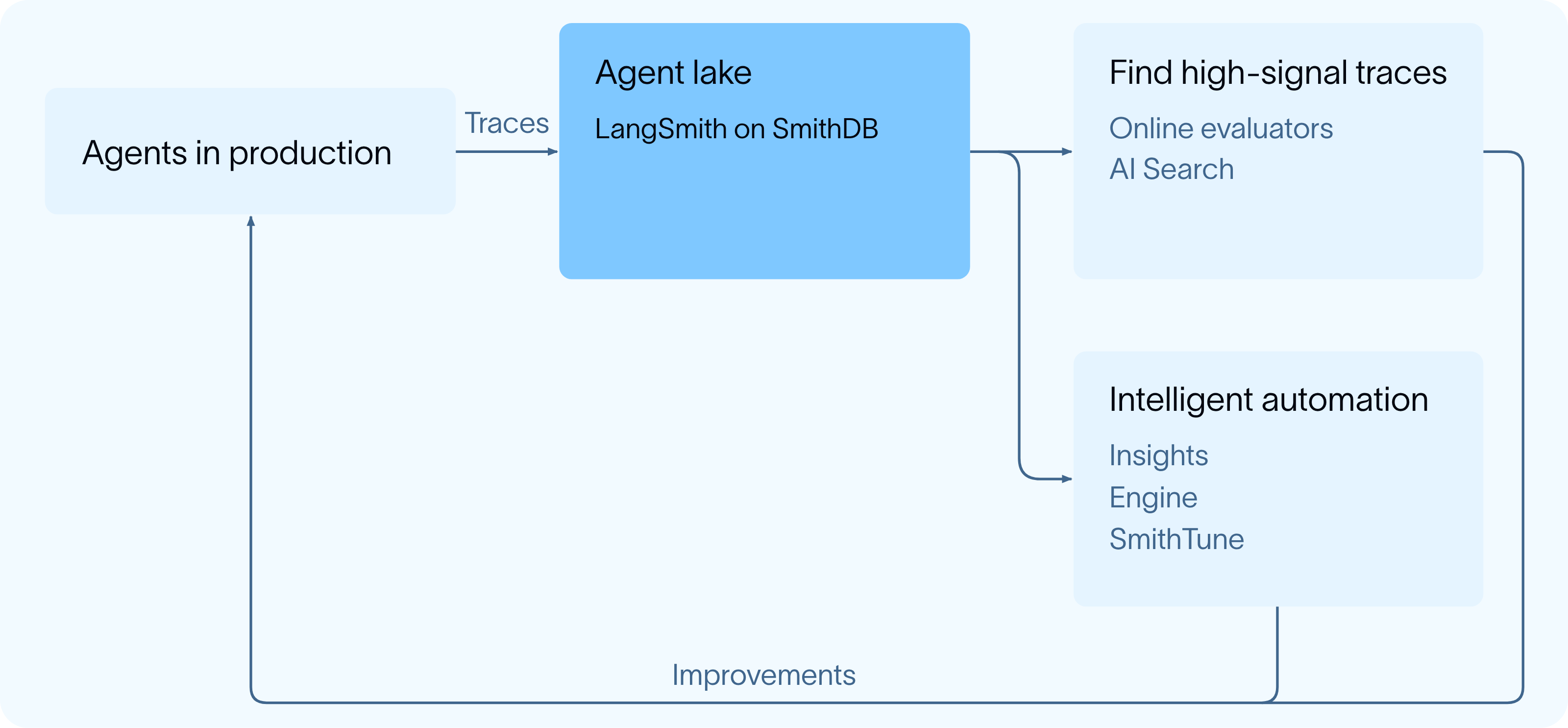
Intelligent compute serves two types of needs: finding useful records among a huge number of traces, and automating the agent improvement loop.
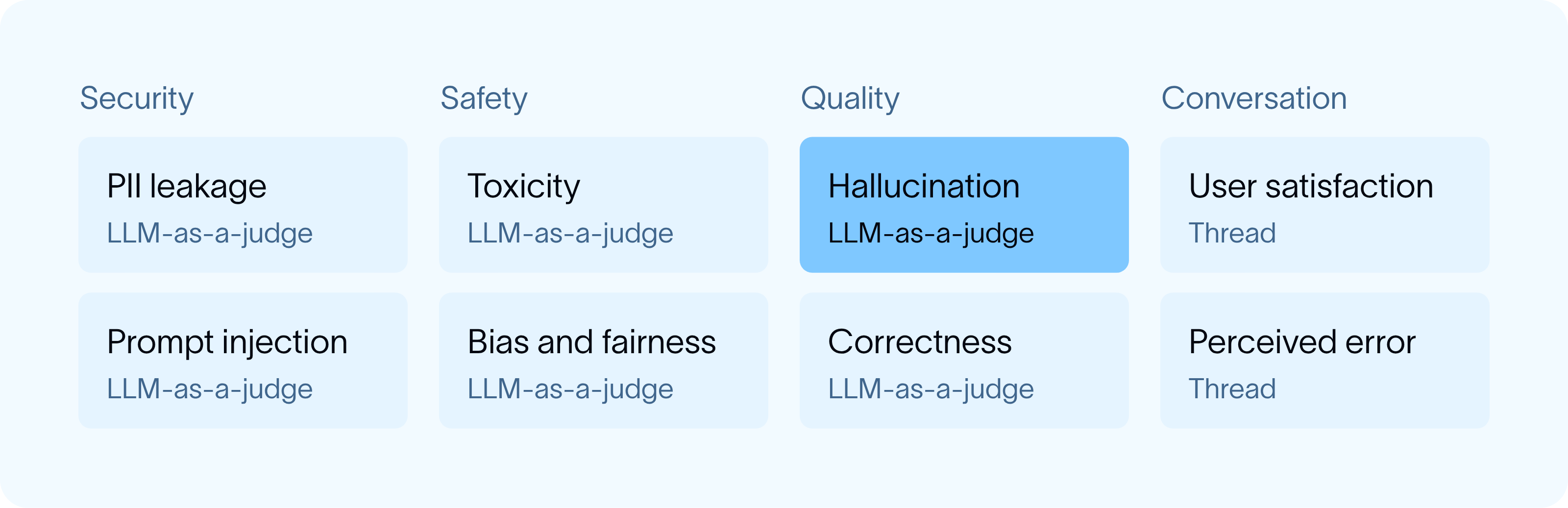
For finding high-signal traces, the starting point is online evaluators. LangSmith has a set of tuned evaluator prompts covering hallucination, toxicity, and user satisfaction. Evaluators leave feedback on traces, and developers filter by feedback. The problem is that online evaluation with LLM-as-a-judge is expensive. TypeSafe AI's decision models offer a low-cost approach, and LangSmith now provides several decision models for trace classification. Another entry point is AI Search, which lets you search traces in natural language, such as threads where users are frustrated or traces containing PII. It runs decision models on search results, adds semantic filtering, and can also be combined with structured queries.
After finding traces, there's still work to do. Insights groups recent traces and answers where the agent fails, and new conversations continue to be classified. Engine periodically scans traces, groups recurring failures into issues, and uses evaluator scores and user feedback to decide where to look. After connecting to a repository, Engine diagnoses root causes and opens fix PRs; v2 will first test against an eval set. Engine has already analyzed more than 60 million production traces. For problems that can't be solved by changing the harness, use SmithTune for fine-tuning. It has been run on Engine itself: fine-tuning Kimi K3 on trajectories from one of Engine's agents, on a subset of IssueBench, the fine-tuned model scored 96, base Kimi K3 scored 90, and GPT-5.6 Sol scored 87.
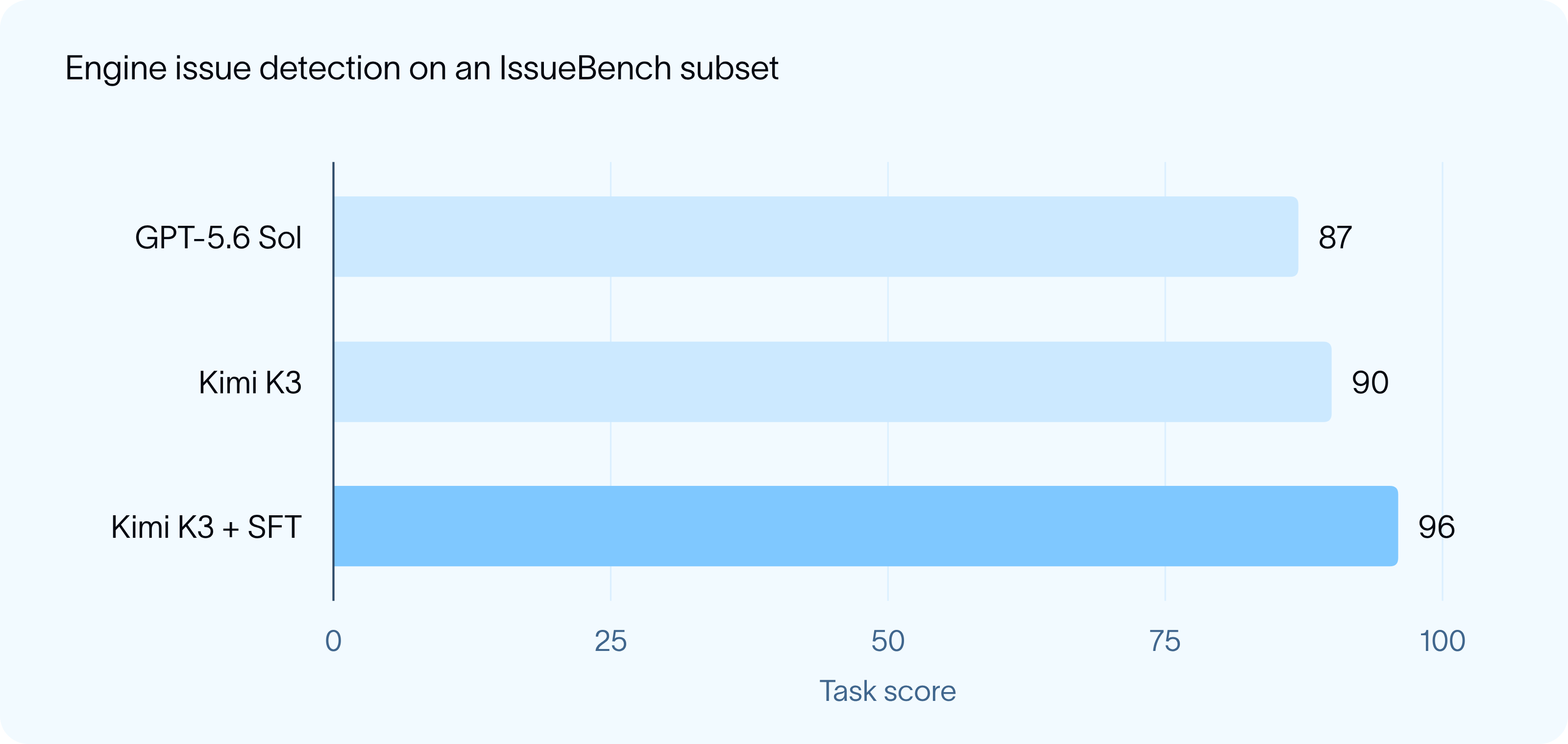
These numbers come from LangSmith's internal benchmark. This is a product blog post, so take them as a reference for now.
Xudong is more concerned with whether the outcome signals themselves are reliable. Thumbs-down from users, LLM scores, and PR merges all have their own biases. If the feedback is skewed, automated improvement will amplify the errors. This concern turned into more concrete operational suggestions in the replies. Commenter Jade suggested adding a time window to the PR merge signal: pull the most recent 30 merged PRs opened by the agent, use git log to check whether the changed files were reverted within two weeks, or were immediately followed by a fix commit. If the proportion is not low, record the outcome as merged with no rework within two weeks, then use that to filter traces and do fine-tuning. Commenter 羊毛总长 mentioned that for coding agents, the exit code of the test command plus how many lines of diff humans changed when merging the PR is more stable than only recording whether it was merged. Recording only merges makes it easy to credit the agent for work that humans had to redo and fix. If the rework rate is also stored in the database, subsequent automated classification and fine-tuning are less likely to go off track. Commenter 小阳哥 said the biggest lesson from running agents is that verification is the hardest step; no matter how beautiful the execution record is, it's useless if the result is wrong.
Some replies also complained that a pile of traces is stored but nobody looks at them. The complaint isn't new, but it's accurate. Storing data is only the prerequisite; outcome signals and follow-up actions are what complete the loop.
For teams building agents, what can be taken away from this post is neither too much nor too little: when storing traces, record outcome signals alongside them; outcome signals must be able to withstand checks around time windows and rework rates; online evaluators, semantic search, automated classification, fix PRs, and fine-tuning are all tools on the same chain. LangChain calls it Agent Lake. The name doesn't matter; what matters is whether the loop can actually turn.
Original post: https://x.com/Xudong07452910/status/2125747613815509247
Original article: https://www.langchain.com/blog/the-agent-lake
发布时间: 2026-11-27 01:31