MCP Isn't Dead, but Only 10 Clients Have Kept Up with the New Spec
In a November 26, 2026 article, Philipp Schmid lays out the bullish case for MCP: Code Mode, Skills, Events, and MCP Apps are pushing MCP toward becoming an agent runtime. StackOne's client scorecard shows the other side: out of 30 clients, full support for Events is 0, and only 10 have kept up with the latest spec.
On November 26, 2026, Niels Rogge recommended Philipp Schmid's new article on X, saying he had finally figured out how Code Mode works. Philipp's conclusion is straightforward: after Skills and CLI became popular, many people talked down MCP, but he has become even more bullish.
Let's fill in the background first. MCP is the Model Context Protocol, an open protocol that lets models connect to external tools, data, and services. Over the past 18 months, it has gone through the full hype cycle. Early excitement quickly turned into backlash and confusion, with the most concentrated complaint being context bloat: tool descriptions and returned results fill up the context.
After Skills emerged, many developers shifted to CLI and progressive disclosure, believing MCP was too heavy. Philipp disagrees with that judgment and offers a set of adoption data: on Linear and Notion, agents create about 2.4 million issues and pages per week, close to half of the total; Notion's MCP traffic grew 60x; Atlassian processes more than 5 million tool calls via MCP every workday, and 44% of those users are not on software teams at all; Neon's agent usage via MCP grows 14% per week; Apple has also begun offering local MCP servers for Pages, Numbers, and Keynote. That 44% at Atlassian is crucial. CLI was never an option for those users.
The protocol itself is also changing. The July 28, 2026 spec removed stateful sessions and added official extensions. Philipp lists four changes.
Code Mode plus typed outputs. Traditional tool calls require the model to round-trip at every step, and all intermediate results go into the context. Doing a data join between two MCP servers amounts to using the model context as memory. Code Mode gives the model a sandbox and exposes MCP tools as callable functions. The model writes a script, calls multiple tools in sequence, filters and joins data in memory, and sends only the final summary back to the context. The prerequisite is that the server declares both inputSchema and outputSchema, so the client can pre-generate typed stubs that connect directly to structuredContent. OpenCode 2.0, Claude Code, OpenAI Codex, Pi, and Factory Droid are already using this pattern. Authentication is also cleaner: MCP clients can handle per-user OAuth 2.1 login and scoped permissions without handing raw API keys to the agent.
Skills come into MCP. Previously, teams had to ship a CLI or MCP server and also maintain a separate SKILL.md. The Skills extension uses skill:// URIs, YAML frontmatter, and a file manifest with SHA-256 digests to put Agent Skills into MCP. When a vendor updates a skill, the digest changes, and clients automatically pull the new version, eliminating manual sync. Anthropic is already beta-testing Skills over MCP in Claude and Claude Code, and Shopify, HubSpot, and Atlassian can provide playbooks based on the logged-in user's and organization's accounts. On connection, only the name and description are injected; the full SKILL.md is read when needed or cached locally by sha256.
Events let agents stay resident and collaborate with multiple people. In the past, MCP integrations were mostly pull-based, so when something went wrong in an external system, the agent didn't know. The Events extension beta lets servers declare capabilities in server/discover and list events with events/list. Clients can subscribe in three ways: webhook sends signed POSTs to a callback URL; stream keeps a long-lived connection for push; poll fetches on a schedule. Clients record a cursor, deduplicate by eventId, and hand events to the harness. A P0 security alert at 2 a.m. or an urgent customer email can wake the agent to pull logs, read threads, and send a triage summary. Shop MCP's order updates and Vercel's deployment.succeeded are already emitting events. Together with Tasks, asynchronous workflows no longer require writing your own webhook glue.
MCP Apps handles interactive interfaces. Returning only JSON and plain text makes it impossible to view p95 latency charts, filter real-time dashboards, or browse design mockups. The MCP Apps extension lets servers return interactive HTML views in a sandbox, and compatible clients can render them inline directly. Slack's new MCP client, Claude's interactive connectors, and Google Antigravity already support this.
Here comes the cold water. StackOne's MCP clients scorecard tests 30 clients every week with the same 11 checks, ranks them from S to D, and links every cell to a live probe, source code, docs, or changelog. As of November 26, 2026, only 10 clients have kept up with the latest MCP spec; no client fully supports Events, and only OpenClaw, Hermes Agent, and ChatGPT partially support it; only VS Code and Claude Code fully support Tasks; only VS Code, Claude Code, and the Claude app support Skills; only goose and Pi fully support Code mode, while Claude Code, OpenClaw, Amp, Droid, Kilo Code, opencode, Qwen Code, and Codex partially support it; 8 clients fully support MCP Apps, and 4 partially support it. The S tier is VS Code, Claude Code, goose, and OpenClaw. The dashboard is at mcpclients.dev.
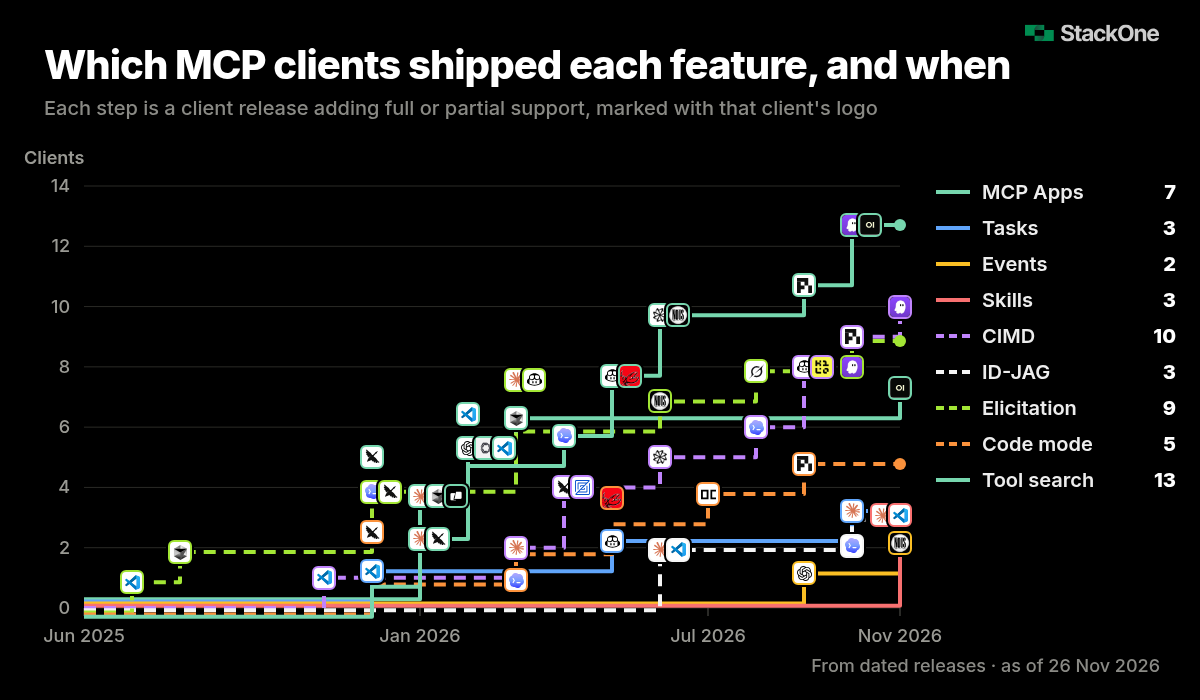
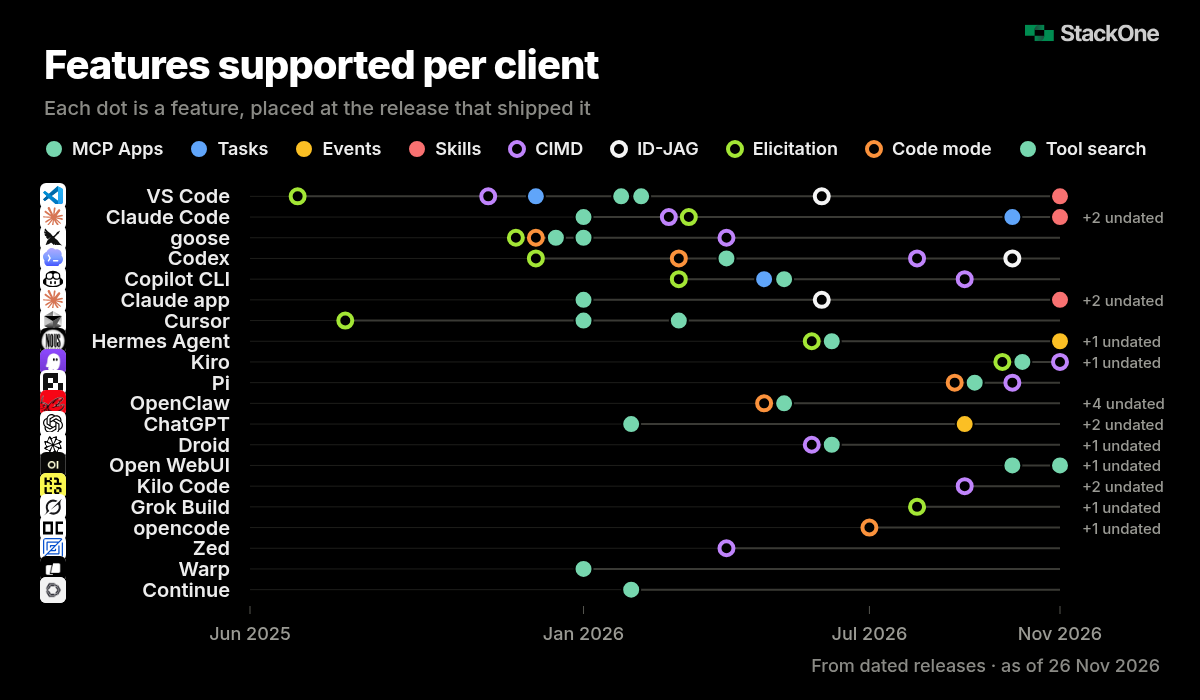
This set of data does not contradict Philipp's optimism. The protocol is evolving healthily, while client implementations are still catching up. The best agent harness in 2027 will likely win on the quality of its MCP integration, and the harness itself should also be an MCP server. Sub-agents run as MCP Tasks; a shared swarm board exposes tools that let agents discover and claim tasks; MCP Events wake the coordinator or peers when a task completes. Philipp also cautions that a good MCP server exposes tools to the agent, rather than wrapping an entire SaaS into an ask_agent endpoint. The latter would cut off the context the agent already has. Long-horizon coordination is where agent-as-MCP-server is actually needed.
What's still missing is also clear: observability and intent—MCP servers can only see tool calls, not the user conversation; discovery via submission to five registries doesn't scale and needs /.well-known plus automated security scanning; on security, untrusted webhooks, the Code Mode sandbox, and embedded UI iframes all expand the prompt injection surface. MCP isn't dead; it has grown from a tool-calling protocol into an agent runtime. The real question is whether clients can keep up.
发布时间: 2026-11-27 05:27