MCP Isn't Dead: 0 of 30 Clients Fully Support Events
Philipp Schmid says he is more bullish on MCP for 2027. Code Mode, Skills, Events, and Apps are all moving forward. StackOne's client scorecard shows the protocol is moving faster than implementations, and full Events support is still zero.
MCP has gone through a complete hype cycle over the past 18 months. First hot, then cold, with context bloat becoming the main complaint. After Skills came out, many developers shifted to CLI and progressive disclosure, and some wrote MCP off entirely. Philipp Schmid recently published a long article, Why I'm Bullish on MCP for 2027. His judgment is that MCP is evolving from a simple tool-calling protocol into part of the agent runtime. The original tweet is here.
Let's start with the data. In Linear and Notion, agents create about 2.4 million issues and pages per week, and Notion reports 60x growth in MCP traffic. Atlassian handles more than 5 million MCP tool calls every business day, with 44% of users coming from outside software teams. Neon's MCP agent usage grows 14% week over week. Apple has also started offering local MCP servers for Pages, Numbers, and Keynote. Demand isn't only coming from people writing code; that signal is more concrete than any launch event.
Philipp divides the changes for 2027 into four areas: Code Mode and typed outputs, native Skills and version control, always-on Events, and MCP Apps.
Code Mode solves the problem of too many tool-call turns. Real tasks often require more than one tool call: look up an issue, pull details, inspect errors, write a summary. If the model decides the next call at every step, intermediate data piles up in the context. Code Mode takes a different approach: it exposes MCP tools as callable functions in a sandbox; the model writes a script, calls, filters, and joins continuously within the script, and puts only the final structured result back into the context. The Linear plus Sentry example is typical: first list open issues in Linear, filter for P0, then batch-query Sentry stats, and finally return only id, title, and the 24-hour event count. The prerequisite is that the MCP server declares both inputSchema and outputSchema so the client can generate typed stubs. OpenCode 2.0, Claude Code, OpenAI Codex, Pi, and Factory Droid are turning Code Mode into a default capability.
Skills is more controversial. Previously, many teams maintained a CLI or MCP server, plus a SKILL.md teaching the agent how to use it. The Skills extension brings Agent Skills into MCP; each skill exposes a skill:// URI, YAML frontmatter, and a file manifest with SHA-256 digests. Digests solve the team synchronization problem: when a vendor updates a skill, the client automatically pulls the new version based on the digest, without manually syncing files. Anthropic is already running a public beta of Skills over MCP in Claude and Claude Code, and Shopify, HubSpot, and Atlassian can provide playbooks by logged-in user and organization. On connection, only the short name and description are injected; when needed, the full SKILL.md is read, or it is cached locally by digest. One commenter joked that Skills made MCP dead for two weeks. Emotional cycles move faster than protocol version iterations.
There is a real concern here. One commenter said that having skills automatically update with the vendor makes him uneasy. His approach is to put skills in a database with versions, evaluations, and approvals, and not let them take effect until signed off. The concern is not unreasonable. The protocol makes synchronization lightweight, but teams still need to decide for themselves who has the authority to change an agent's behavior.
Events is another key change. In the past, MCP integrations were basically pull-based: when something happened in an external system, it could not proactively wake the agent. The Events extension is now in Beta and supports three delivery methods: webhook, where the server sends a signed POST to a callback address; stream, where events are pushed over a long-lived connection; and poll, where the client periodically queries with a cursor. The MCP client is responsible for tracking the cursor, deduplicating by eventId, and handing events to the harness. Philipp gives the example of a P0 security alert at 2 a.m.; the agent is woken up, pulls logs, checks recent discussions, and sends a triage summary. Shop MCP's order updates and Vercel's deployment.succeeded are already being integrated.
But here we need to pour some cold water. StackOne maintains an MCP client scorecard that ranks 30 clients every week against the same 11 checks. As of November 26, 2026, full Events support is 0; only OpenClaw, Hermes Agent, and ChatGPT partially support it. Full Skills support is 3, full Tasks support is 2, full MCP Apps support is 8, and full Code Mode support is 2. The protocol exists, the feature list is written, but client implementations still lag behind.
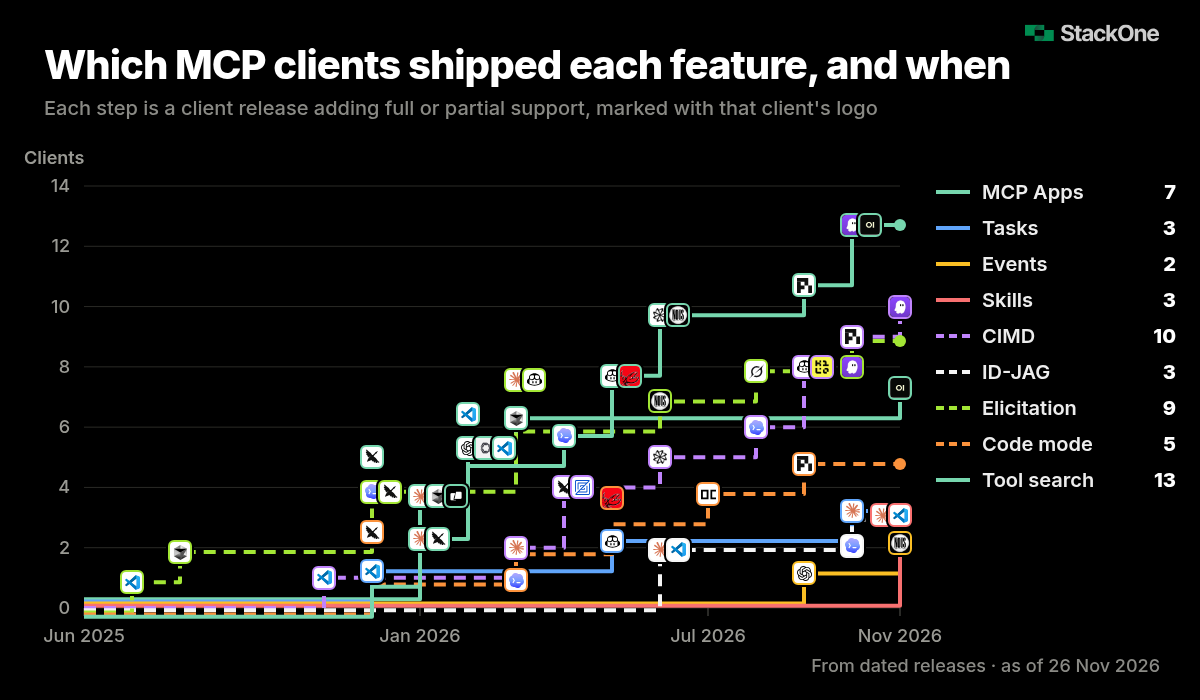
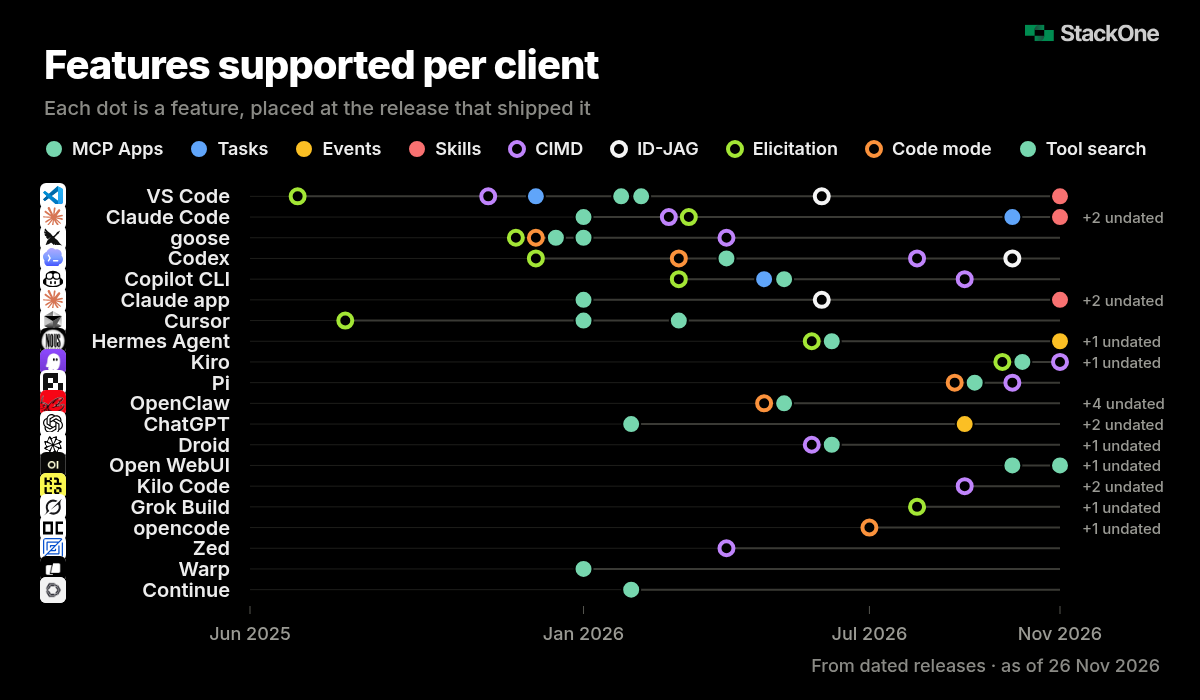
The S tier of this scorecard is VS Code, Claude Code, goose, and OpenClaw. The A tier includes Claude app, Copilot CLI, Kiro, Amp, Hermes Agent, Pi, Cursor, Droid, ChatGPT, and Kilo Code. The scoring dimensions are not just spec version, but also MCP Apps, Tasks, Events, Skills, CIMD, ID-JAG, Elicitation, Live tool lists, Code mode, and Tool search. The full table is at mcpclients.dev, and every cell links to source code, docs, or changelog. For teams preparing to migrate, this table is more useful than a feature marketing page.
One commenter asked: isn't MCP just an API plus a help endpoint? If you only look at tool discovery, it does look that way. What MCP is pushing forward now is on the client side: per-user OAuth 2.1 login, scoped tool permissions, typed structuredContent, multimodal returns, Skills versions, Events deduplication, and MCP Apps sandbox UI. These capabilities let agents avoid needing raw API keys and reduce manual glue. Treating it as a pure API misses the point.
MCP Apps fills in the interaction layer. Servers can return sandboxed HTML views, and clients can directly view p95 latency charts, filter real-time dashboards, and browse design mockups. Slack's new MCP client, Claude's interactive connectors, and Google Antigravity already support this. The scorecard shows 8 clients with full support and 4 with partial support.
Philipp doesn't avoid the problems either. MCP servers can only see tool calls, not user conversations; intent and observability remain gaps. Feedback tools like Cloudflare's submit_feedback can fill a little of that, but most servers still don't know why a call was made. Discovery is also fragmented; submitting to five registries doesn't scale, and cleaner /.well-known and automated security scanning are needed. Untrusted webhook payloads, Code Mode sandboxes, and embedded UI iframes all expand the prompt injection surface.
A more conservative judgment is that MCP isn't dead; what's dead is the usage pattern that treats it as a single tool call. In 2027, what really separates clients may be how well they support Code Mode, Skills, Events, and Apps. Philipp even thinks the best agent harness should itself be an MCP server: sub-agents run as MCP Tasks, a shared swarm board exposes tools, and Events wake the coordinator when a task completes. Whether this direction works depends on whether client implementations can catch up with the protocol. At least for now, the scorecard is more honest than launch events.
发布时间: 2026-11-27 06:26