After handing video editing to Claude Code, they built a GitHub for agents
Riley Brown releases v2video, free and open source, saving the prompt, files, and comments for every edit, with rollback, comparison, and fork. Video tools were released in droves in November; what's truly scarce is a traceable editing process.
Riley Brown has released v2video, with a very direct positioning: GitHub for agentic video editing, free and open source.
The problem it solves is not flashy: every time a video project changes, it saves a version, along with the prompt, files, and comments at that time. Agents can look back at these records and know what you like and dislike. Riley Brown's judgment is that within 18 months, the main video editor will become agents like Claude Code, Codex, and Antigravity.
v2's approach is very restrained: it does not make a timeline editor, and works with tools such as Tesseract, Hyperframes, and Remotion. The integrations listed on the official website include Grok Bot, Codex, Claude Code, dots, and Antigravity; any agent that can run commands locally can also connect.
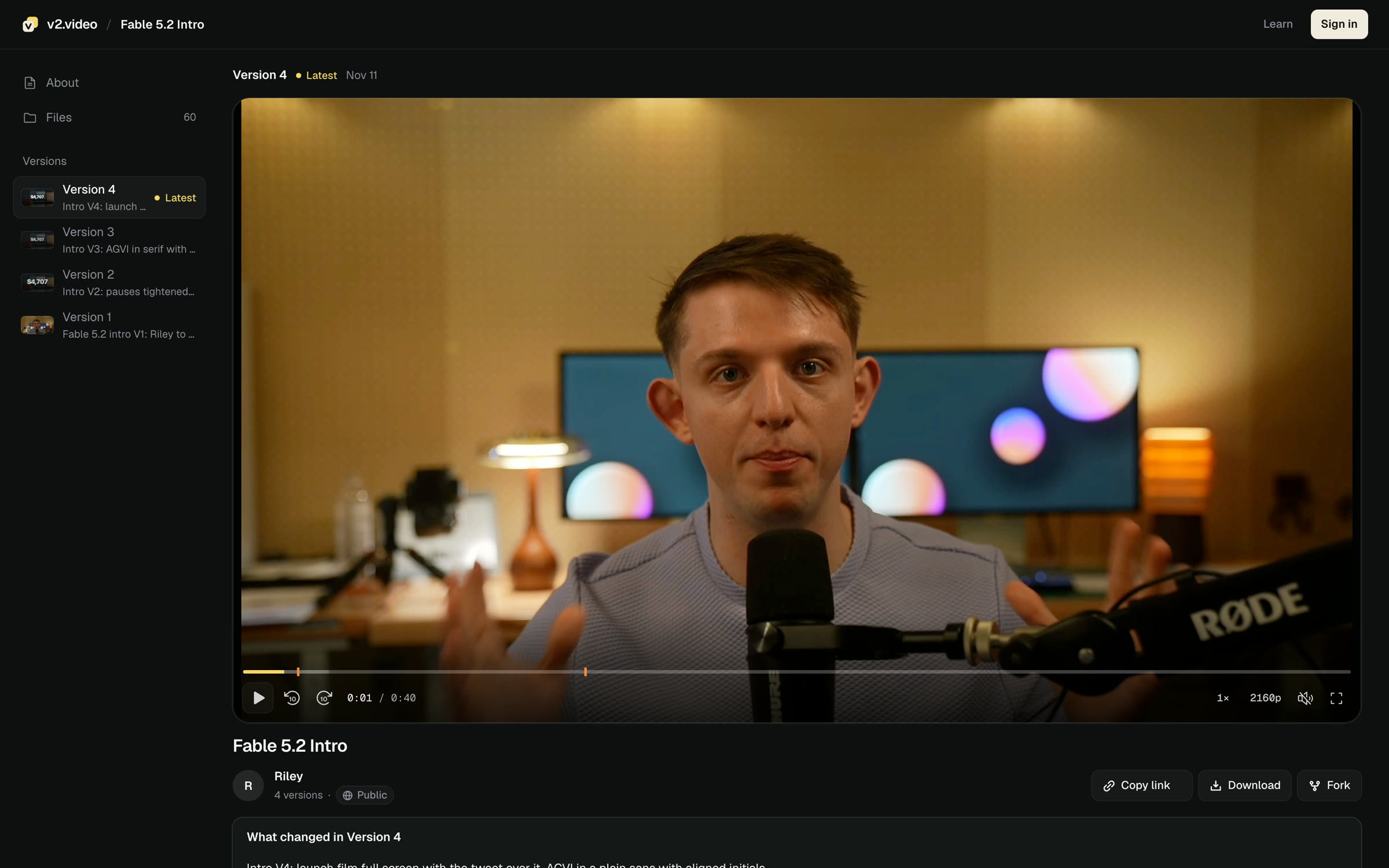
The core workflow can be broken into four steps:
v2 initinitializes the project and teaches the agent to save a version after every edit, together with the corresponding prompt.v2 loglists all versions, newest first.v2 diffopens versions in the browser, where they can be viewed individually or compared side by side; leave a comment at a certain point in time, and the agent reads the comment and continues editing.v2 restore 3precisely returns to version 3 and saves it as a new version;v2 pushuploads to v2.video and generates a private link.
Installation requires git and ffmpeg; macOS and Linux can run the install script. Release packages are signed, and v2 update checks the signature before replacing itself. Code and text go through git, while footage, music, and renders go into v2's own store, and any version can be precisely restored. The CLI is open source on GitHub under the MIT license, and the hosted version is free at v2.video.
cd your-video-project
v2 init
claude
v2 log
v2 diff
v2 restore 3
v2 push
Public projects turn every video into a template. Set a project to public, and anyone can fork any version and paste a prompt into their own agent to continue editing. It sounds like code collaboration for video, but there is a key question that has not yet been expanded on in the tweet: a user asked whether forking a public project gives you the original author's assets or only the prompts. This question will determine whether it is more like template sharing or more like an asset library.
Another practical piece of feedback came from a user: Claude made 18 cuts for a video, and asset files were copied to a new worktree; does v2 use a conventional git-style API? The GitHub explanation answers half of it: code and text go through git, and assets and render results go into v2's own store. The remaining half can only be known by actually using it.
v2 did not appear out of thin air. According to Konstantin Kanin's count, at least 24 video tools were released or updated in November. sunday.'s count is more specific: 12 different video editors launched this month. The list includes Gorg, Editroom, Kino, Scarlet, Dailies, Lazycow, v2video, and Wrap, which Dan Vega added.

Professional editors will say that most of these are wrappers around Claude plus ffmpeg. That statement is half true; underneath, there is indeed a lot of agents, ffmpeg, and rendering pipelines. But a few years ago, many people had to learn Premiere or Resolve first in order to edit interviews, tutorials, and short videos, and half of those features were useless. Now you can build tools for your own workflow; the cost has changed.
Scarlet is another direction. It is open source and supports macOS, Windows, and Linux. Users can use text, voice, or directly draw a box on a paused frame to tell Claude Code, Codex, and Gemini what to change. The agent edits the cut list, and Scarlet only renders the affected few seconds; the original footage is untouched, and every version is saved non-destructively. It can also export MP4, subtitles, or generate FCPXML and OTIO to hand off to Resolve, Final Cut, and Premiere. Matthew Berman suggested in a reply that v2 and Scarlet collaborate, and Riley Brown said he would test it over the weekend.

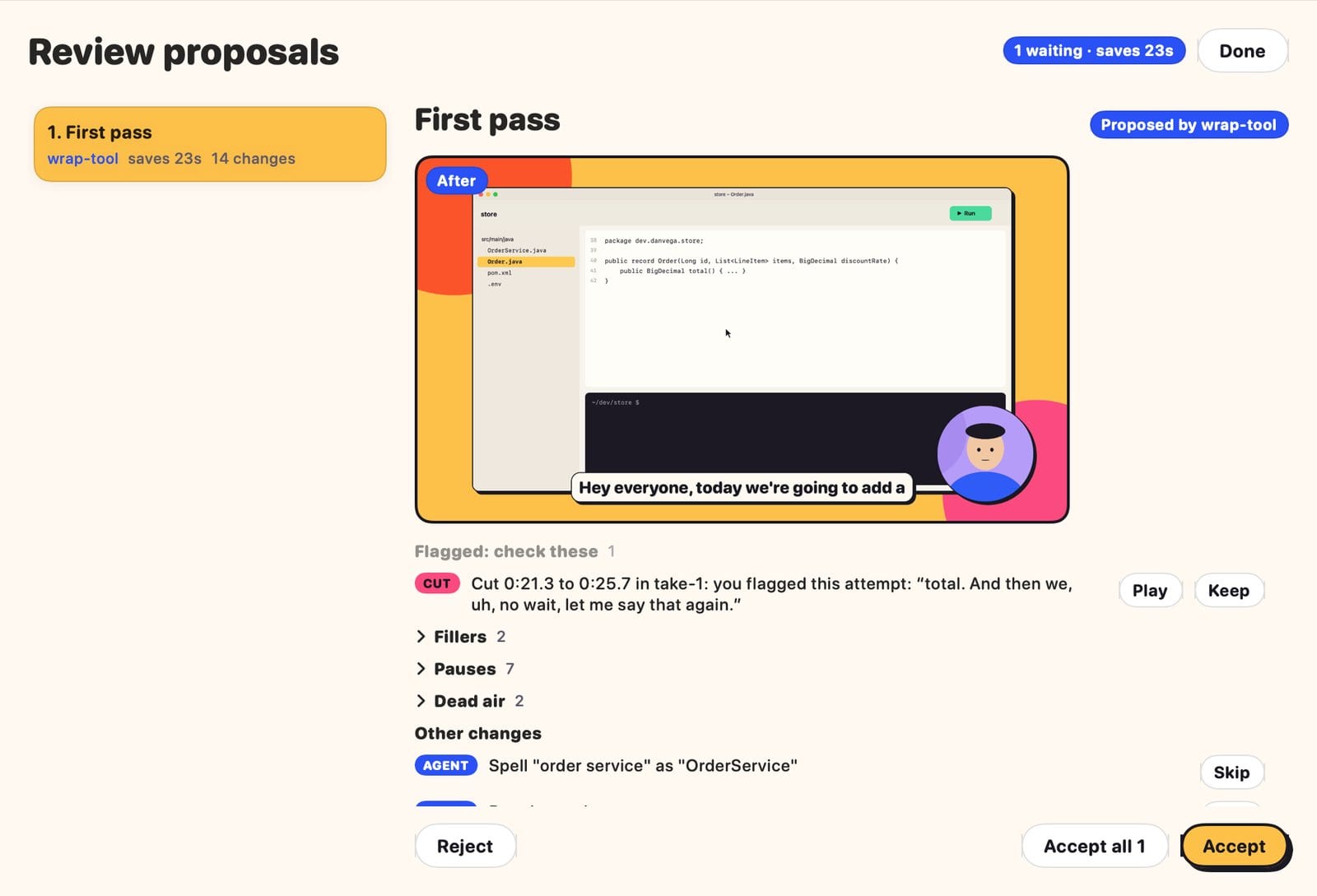
Wrap captures another detail: a read-only transcript is not enough. It records the screen, camera, and audio, while also recording terminal commands, test runs, file focus, clicks, and input; secrets are masked before being written. The agent reads this event log and proposes where to speed up, where to zoom in, and where to cut. By default, all changes wait for user approval. Without an agent, Rough cut can also remove pauses, remove filler words, and speed up build waits.
Looking at these tools together, the competitive point has changed. Generating a shot and automatically cutting out pauses are no longer scarce. What is scarce is remembering why a change was made, who approved it, where the assets are, whether it can be rolled back, and whether someone else can continue editing. Video editing is changing from a single timeline into a version repository plus agent sessions.
For those who want to try v2, first install git and ffmpeg, then run the install script. Ordinary users should first look at two things: whether forking a public project actually includes the assets, and whether you can review the versions edited by the agent. Editing is still creation; the agent has just taken over repetitive operations and version records.
发布时间: 2026-11-28 11:27